 Draxon VR Training Syllabus
VR Training
De-icing
 Virtual Reality
Description
The De-icing VR Training Course equips de-icing operators with the knowledge and confidence to operate a de-icer and remove snow, ice and frost from an aircraft before departure. Trainees learn the de-icer and its controls, then apply the correct spray technique and job sequence at the aircraft, recording each job on the Data Transmission System. Built-in error scenarios reinforce spray distance, correct sequencing and no-spray discipline. The result is faster qualification, fewer aircraft damage incidents, and consistent de-icing standards across stations.
Scope of Course
- Course with 10 lessons across theoretical and practical training; includes an exam, a scored spray practice and a final assessment
- Covers all de-icing operations: inspection, cabin controls, spray technique, positioning, de-icing and job recording
- Designed for de-icing operators, from new starters to experienced professionals
Languages
English, German, Dutch, Spanish, French, Greek, Arabic, Cantonese Chinese, Turkish
Duration
Initial Training: 103 Minutes
Recurrent Training: 45 Minutes
Audience
Ground Handling Operators
New Starters & Professionals
Standards
SAE AS6285F
SAE AS6286E
Equipment
Vestergaard Elephant BETA
Reference: Airbus A320
Foundational Training
Learning Outcomes
- Ensures understanding of de-icer components, fluid types and safety systems
- Builds confident control of the operator cabin, the boom and the nozzle
- Establishes the correct spray distance and wing de-icing technique
- Reinforces a structured pre-shift walkaround, including the refractometer test
- Promotes safe driving and spraying habits around the de-icer
Training Methodology
- Immersive Virtual Reality simulation of a de-icing pad in winter conditions with a fully modelled de-icer
- Realistic operator cabin interaction including both joysticks, spray settings, drive mode and the information display
- Step-by-step guidance with demonstrations, highlighted boom positions, and voice and visual cues
- Scored spray practice rating time, fluid used, spray order and spray distance at three levels
- Knowledge assessment through multiple-choice examination and continuous evaluation
Operational Training
Learning Outcomes
- Develops complete de-icing jobs on the Data Transmission System, from job acceptance and procedure and fluid selection to recording the treated parts and working positions
- Ensures accurate positioning of the de-icer at the aircraft, stopping in the working position clear of the wings and the fuselage
- Trains wing de-icing from the wing tip to the wing root, spraying from the leading edge toward the trailing edge with the nozzle 1 to 1.5 meters above the surface
- Establishes top-down, front-to-back fuselage de-icing in two sections, spraying above windows and doors so the fluid runs over them
- Reinforces no-spray discipline for the engine inlet, cockpit and cabin windows, doors, emergency exits and sensors
- Trains tail de-icing, the vertical stabilizer from the top down and the horizontal stabilizer from the tip toward the fuselage
- Validates the complete de-icing job on the whole aircraft through an assessment with 10 required criteria
Training Methodology
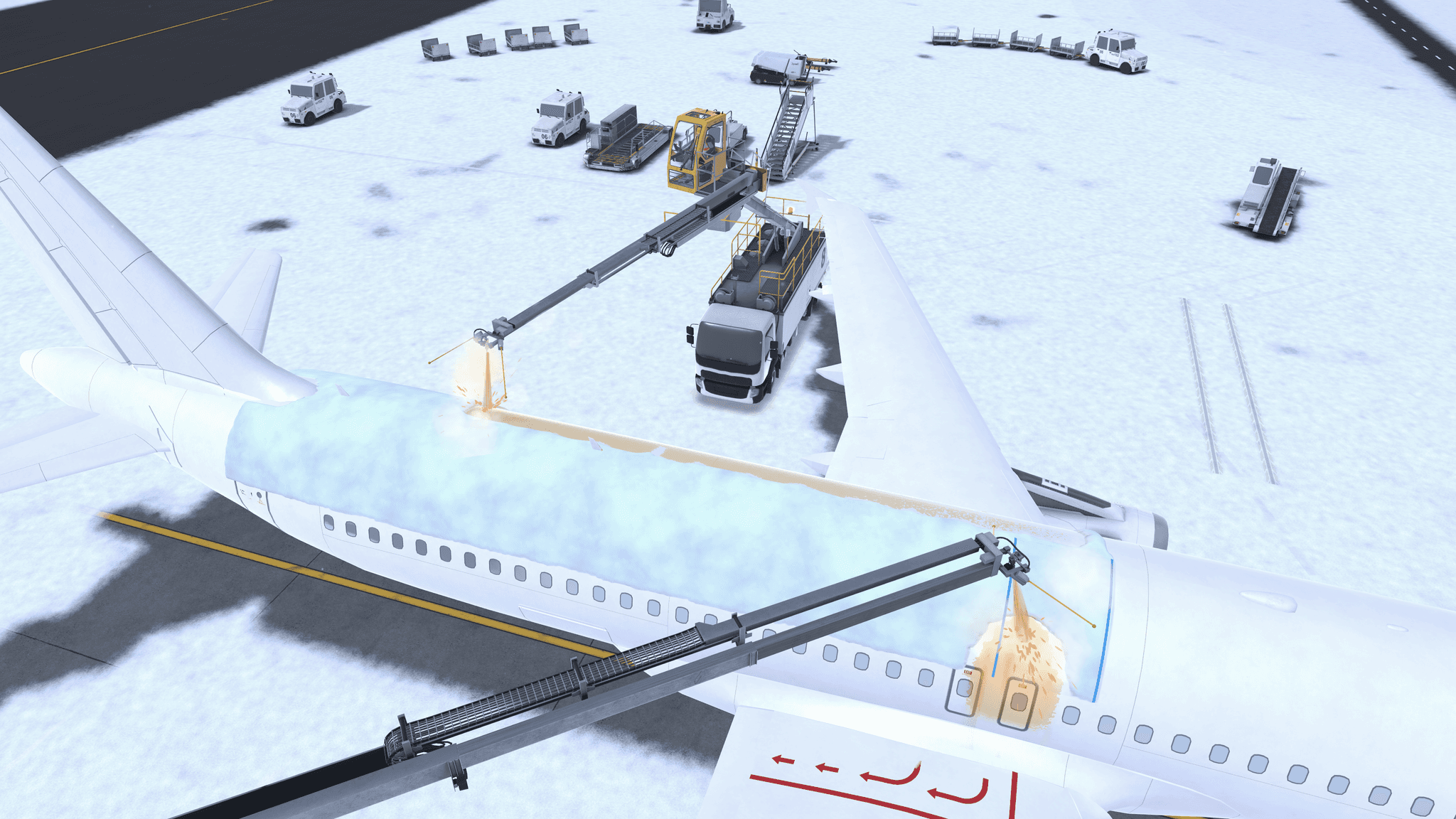
- Immersive Virtual Reality simulation of an open stand with an Airbus A320 and a second de-icer working the other side
- Realistic de-icing workflows including job handling on the Data Transmission System, driving into the working position and strip-by-strip spraying
- A demonstration with a second de-icer before each task, with highlighted strips, marked no-spray zones and spray distance guidance
- Built-in safety scenarios exposing trainees to common errors such as spraying into the engine inlet, spraying windows and doors directly, spraying from too far away, and proximity sensor contact with the aircraft
- A complete practice job on the whole aircraft, scored on time, fluid used, spray order and spray distance
- Assessment with no guidance until the end, followed by a replay of the whole job in the VR app and the Trainer Portal
Recurrent Training
Learning Outcomes
- Refreshes and validates knowledge of the de-icer, its fluids and its safety systems through the exam
- Repeats the pre-shift walkaround, including the refractometer test of the fluid mix
- Restores a precise spray technique through the scored spray practice
- Rebuilds the complete de-icing job on the whole aircraft before it is assessed
- Validates continued competency through an assessment with 10 required criteria
Training Methodology
- Condensed format for experienced operators, built from five lessons of the initial training
- Theory exam and scored spray practice, followed by a complete practice job with help only when needed
- Assessment with no guidance and no feedback until the end, followed by a replay of the whole job
- Results for every criterion in the Trainer Portal to identify and address skill gaps