Draxon VR Training Syllabus
Walkaround
 Virtual Reality
Description
This lesson trains the walkaround inspection of a de-icer before every shift, to confirm it is safe and ready to work on an aircraft. Trainees inspect the de-icer on the ground, at the telescopic boom and inside the operator cabin, and finish with a refractometer test of the Type I fluid mix. The lesson builds recognition of faults that affect the de-icer's roadworthiness, its protection of the aircraft, the operator's safety and visibility, and the quality of the fluid sprayed.
Description
This lesson trains the walkaround inspection of a de-icer before every shift, to confirm it is safe and ready to work on an aircraft. Trainees inspect the de-icer on the ground, at the telescopic boom and inside the operator cabin, and finish with a refractometer test of the Type I fluid mix. The lesson builds recognition of faults that affect the de-icer's roadworthiness, its protection of the aircraft, the operator's safety and visibility, and the quality of the fluid sprayed.
Lesson Overview
- 1Introduction to the checklist and how to mark items as in order or faulty
- 2Inspect the de-icer on the ground
- 3Inspect the telescopic boom from the walkway
- 4Inspect the operator cabin and test the Type I fluid mix
- 5Validate decisions and confirm whether the de-icer can be used or must be reported
Skills Acquired
- Recognize leaks, tire and wheel faults and body damage that make a de-icer unsafe to drive
- Identify damage to the proximity sensors, sight rods, boom, hoses and nozzle that affects safe spraying
- Read a refractometer and confirm the Type I mix matches the value on the fluid specification
- Understand that a de-icer with a fault is reported and replaced, never taken into operation
- Understand the safety significance of each inspection point for protecting the aircraft, the operator and the de-icing result
Lesson Procedure
- The trainee starts at the de-icer parking area after a night of snow, with a checklist tablet in the left hand.
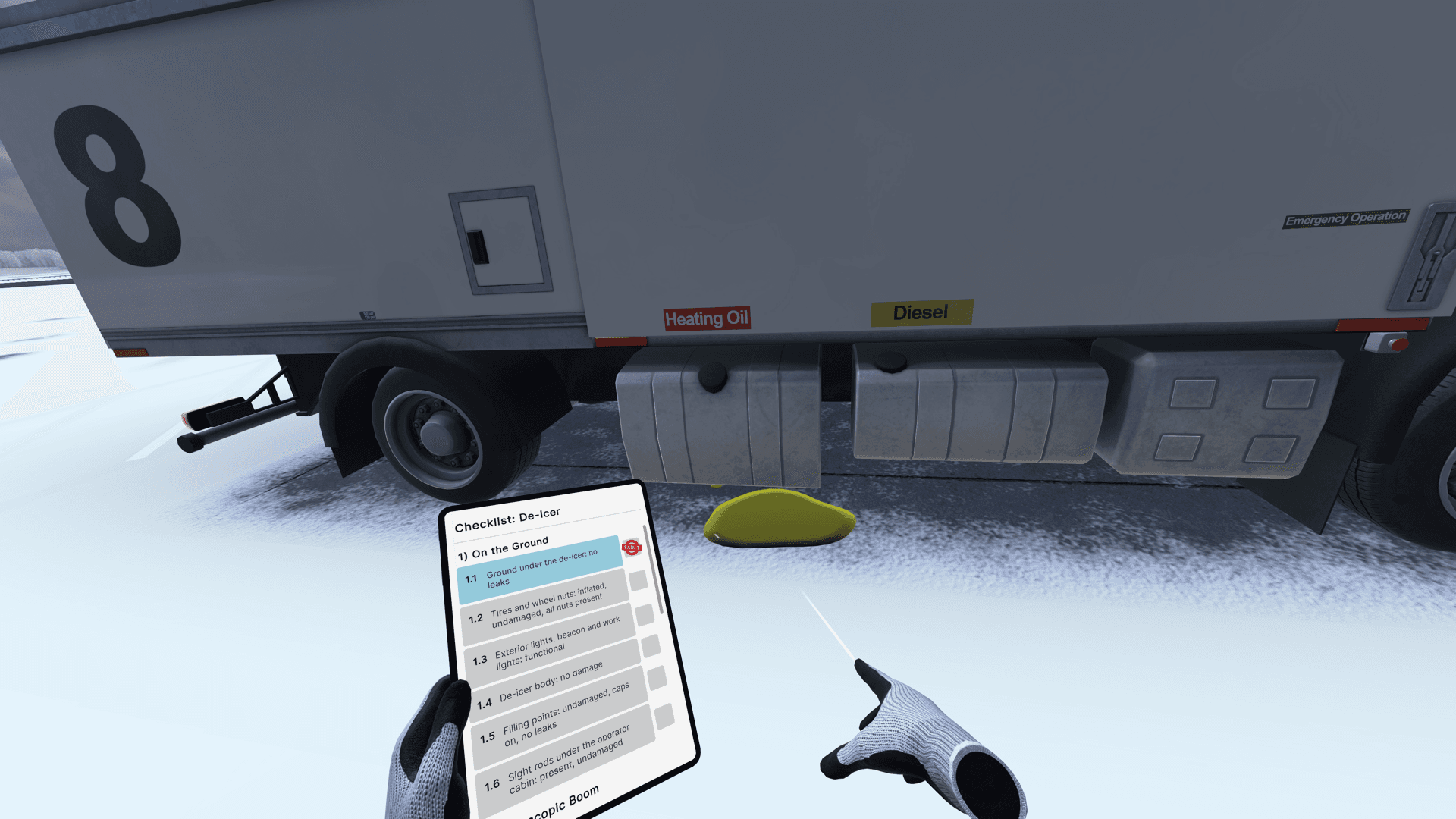
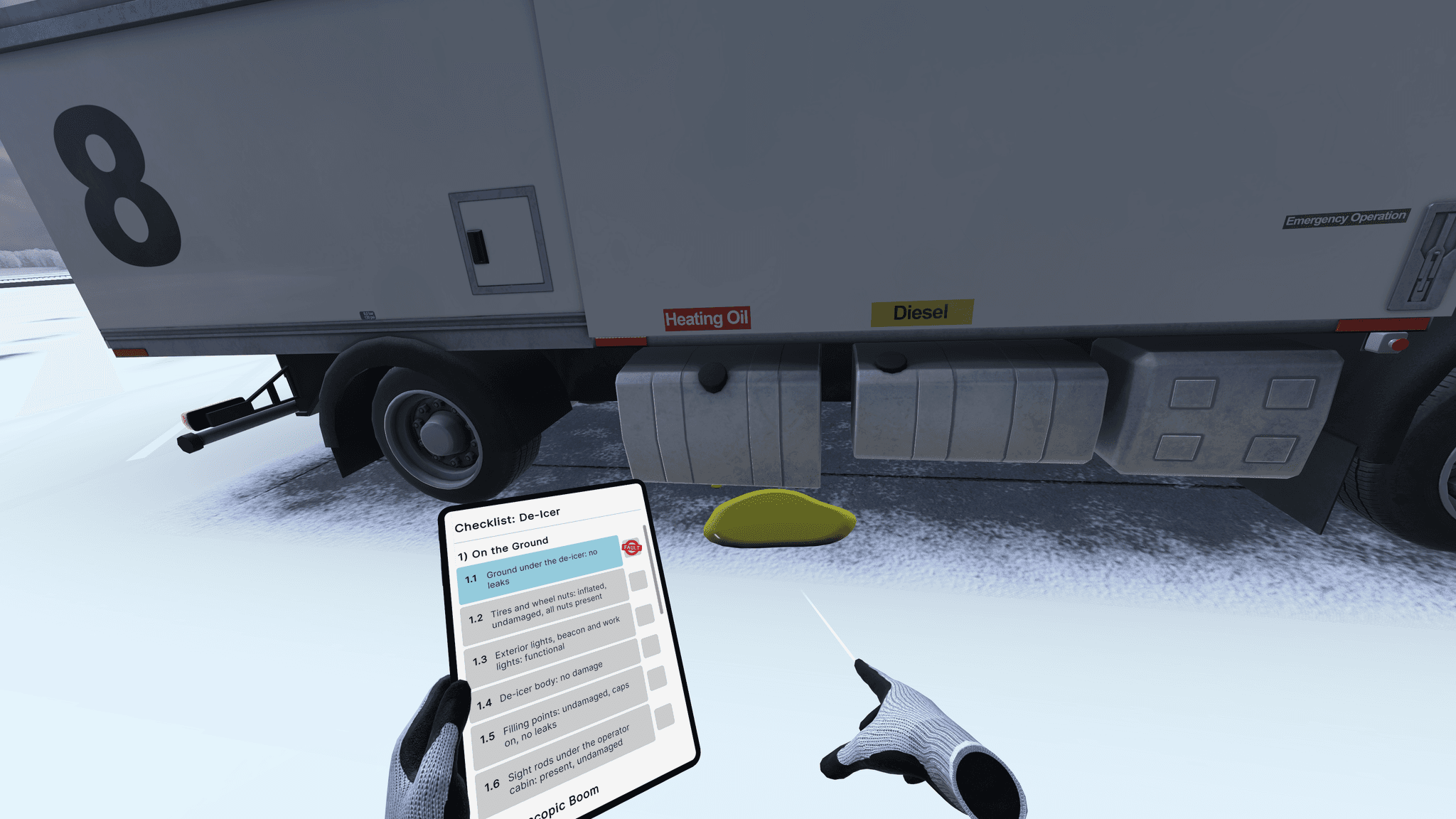
- Ground under the de-icer: puddles or stains from de-icing fluid, hydraulic oil or fuel. Tires and wheel nuts: cuts, bulges, a flat tire or missing wheel nuts.
- Exterior lights, beacon and work lights, switched on for the check: any light that stays dark. Body: deep cuts, major dents or loose parts.
- Filling points: damage, missing caps or leaks. Sight rods under the operator cabin, which show the length of the de-icer while driving: bent or missing rods.
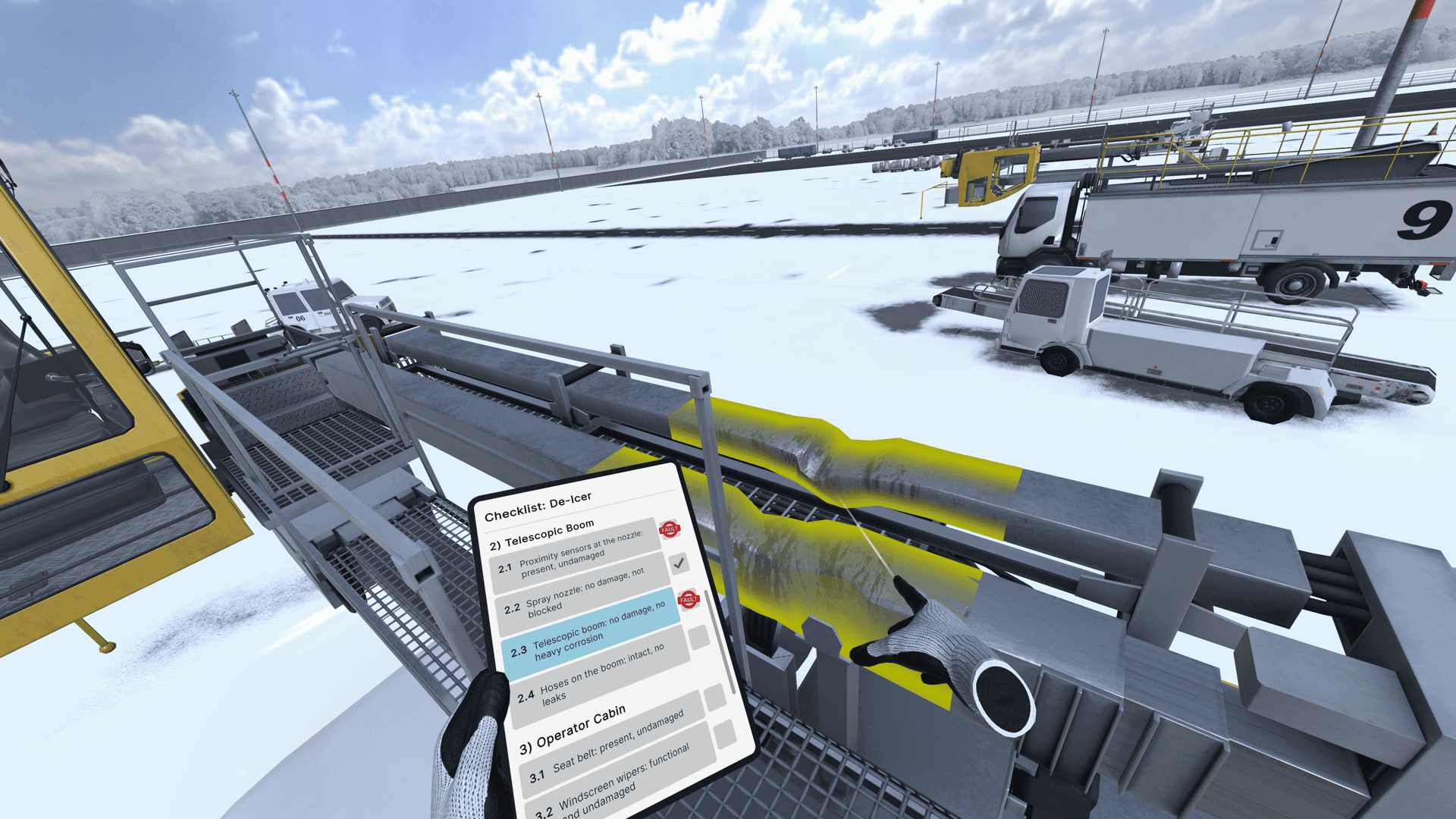
- After climbing to the walkway and turning the operator cabin into its working position: proximity sensors at the nozzle head, damaged or missing; spray nozzle, damaged or blocked; telescopic boom, damage or heavy corrosion; boom hoses, cracks, worn spots or leaks.
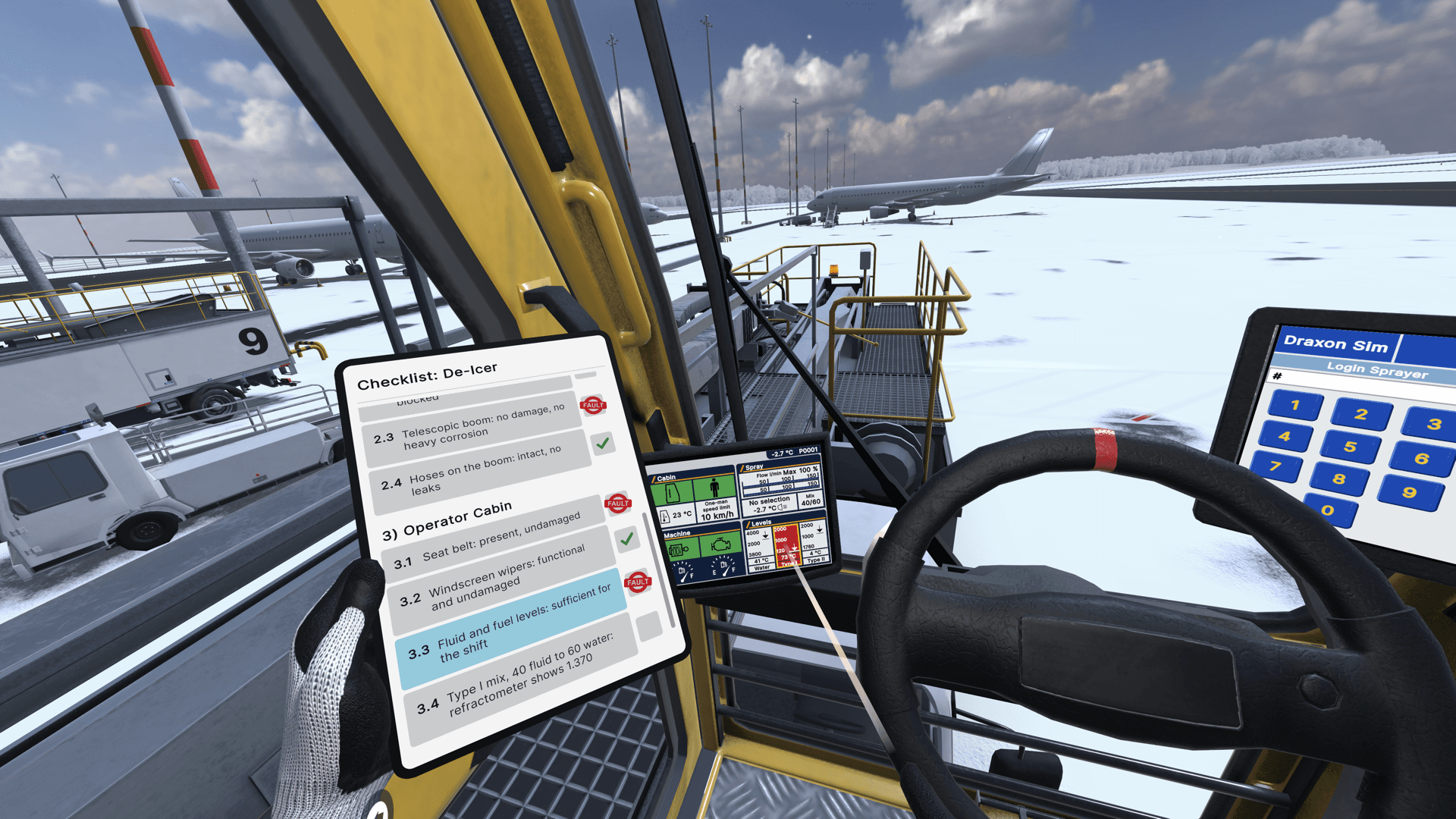
- Inside the operator cabin: seat belt webbing and buckle, cut or frayed; windscreen wipers, a wiper that does not move; information screen, low fluid or fuel levels.
- Refractometer test: the reading of a sample taken at the nozzle must match the value for the set Type I mix, 1.370 for 40 parts fluid to 60 parts water.
- Each item is marked as in order or faulty. Marking a faulty item as in order triggers an error, and the item must be inspected again.
Safety Scenarios & Learnings
Puddle under the de-icer
Reinforces that a fluid, hydraulic oil or fuel leak must be checked before the de-icer is used.
Reinforces that a fluid, hydraulic oil or fuel leak must be checked before the de-icer is used.
Flat tire with missing wheel nuts
Demonstrates that a wheel can fail on a heavy vehicle that drives right next to aircraft.
Demonstrates that a wheel can fail on a heavy vehicle that drives right next to aircraft.
Work light out
Reinforces that de-icing happens in darkness and bad weather, where every light is needed to judge the surface.
Reinforces that de-icing happens in darkness and bad weather, where every light is needed to judge the surface.
Deep cut in the body
Highlights that body damage can stop parts of the de-icer, such as doors, from working.
Highlights that body damage can stop parts of the de-icer, such as doors, from working.
Missing filling cap
Reinforces that an open filling point lets water and dirt into the tank and makes the fluid unusable.
Reinforces that an open filling point lets water and dirt into the tank and makes the fluid unusable.
Bent sight rod
Shows that a bent rod no longer indicates the length of the de-icer while driving.
Shows that a bent rod no longer indicates the length of the de-icer while driving.
Damaged proximity sensor
Highlights that a damaged sensor may not stop the boom before it touches the aircraft.
Highlights that a damaged sensor may not stop the boom before it touches the aircraft.
Damaged spray nozzle
Reinforces that a damaged nozzle cannot produce a reliable spray pattern.
Reinforces that a damaged nozzle cannot produce a reliable spray pattern.
Damaged telescopic boom
Reinforces that a damaged boom must not be extended over an aircraft.
Reinforces that a damaged boom must not be extended over an aircraft.
Split boom hose
Highlights that hot fluid escaping under pressure endangers everyone around the de-icer.
Highlights that hot fluid escaping under pressure endangers everyone around the de-icer.
Cut seat belt
Reinforces that a damaged belt may not hold the operator working at height or driving.
Reinforces that a damaged belt may not hold the operator working at height or driving.
Wiper not moving
Shows that the operator loses sight of the surface as soon as the weather turns.
Shows that the operator loses sight of the surface as soon as the weather turns.
De-icing fluid tank nearly empty
Reinforces that tanks are refilled before the shift, not in the middle of a treatment.
Reinforces that tanks are refilled before the shift, not in the middle of a treatment.
Refractometer reading too low
Demonstrates that a mix with too much water can freeze on the aircraft at the current outside temperature.
Demonstrates that a mix with too much water can freeze on the aircraft at the current outside temperature.
Gallery