 Draxon VR Training Syllabus
VR Training
Hand Signals
 Virtual Reality
Description
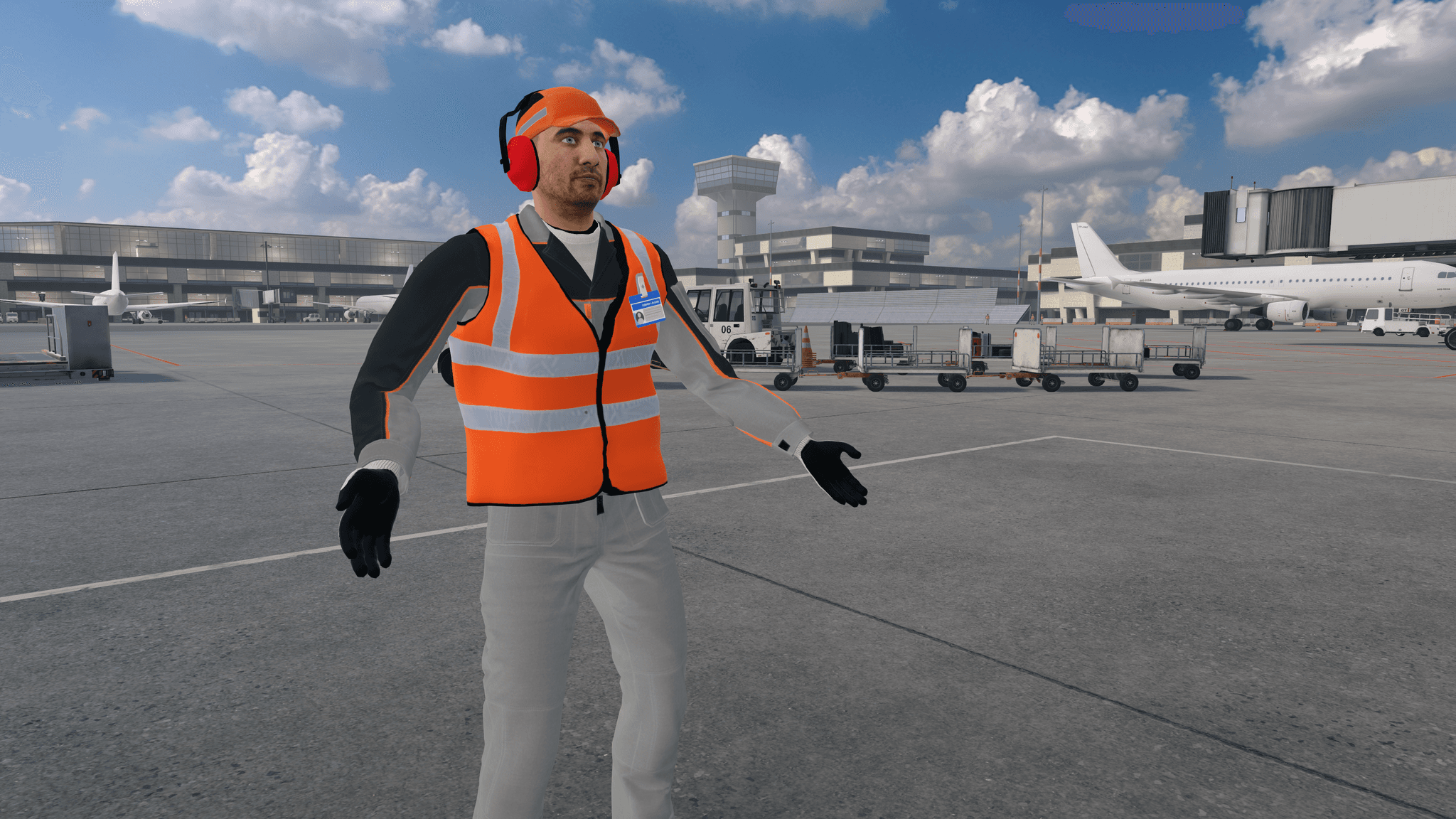
The Hand Signals VR Training Course equips ramp personnel with the skills and confidence to recognize and perform the full set of 27 standard hand signals used in ground handling operations. For each signal, a colleague demonstrates it and then holds the pose as a live reference while the trainee performs it in real time, coached on correct hand state, orientation, and motion. Two exams then assess recognition and hands-on performance, building the reliable, unambiguous signalling that keeps apron communication safe.
Scope of Course
- Course with 4 lessons combining hands-on practice and assessment
- Covers 27 standard hand signals spanning movement and direction, vehicle operations, and pushback coordination
- Includes two exams assessing signal recognition and hands-on performance
- Designed for ground handling personnel, from new starters to experienced professionals
Languages
English, German, Dutch, Spanish, French, Greek, Arabic, Cantonese Chinese, Turkish
Audience
Ground Handling Operators
New Starters & Professionals
Duration
22–26 Minutes
Standards
IATA: AHM 1110, Edition 46
IATA: IGOM, Edition 14
Foundational Training
Learning Outcomes
- Builds recognition of the full standard set of ramp hand signals
- Develops correct execution of each signal, from hand shape and orientation to motion and hold
- Builds the muscle memory to perform signals reliably from memory on the ramp
- Reinforces awareness of paired signals with opposite meanings and the risk of confusing them
- Promotes uniform signalling standards for safe, unambiguous apron communication
Training Methodology
- Immersive VR simulation placing trainees on a busy apron with a colleague demonstrating each signal
- A continuous watch-then-perform flow: the colleague holds each pose as a live reference while the trainee performs it in real time
- Step-by-step coaching on hand orientation, motion, and hold, with correction of common mistakes
- Built-in error detection for confusable and inverted signals with corrective feedback
- Two exams assess signal recognition and hands-on performance, including a graded performing exam