Draxon VR Training Syllabus
Recognizing and Performing: Part 1
 Virtual Reality
Description
This lesson trains ramp personnel to recognize and perform 13 core hand signals used to direct vehicle and GSE movements on the apron. A colleague first demonstrates each signal, then holds the pose as a live reference while the trainee performs it, with coaching on form and correction of common mistakes. The lesson builds the muscle memory and precise, recognizable signalling needed to communicate when noise, distance, or radio silence make spoken words impossible.
Description
This lesson trains ramp personnel to recognize and perform 13 core hand signals used to direct vehicle and GSE movements on the apron. A colleague first demonstrates each signal, then holds the pose as a live reference while the trainee performs it, with coaching on form and correction of common mistakes. The lesson builds the muscle memory and precise, recognizable signalling needed to communicate when noise, distance, or radio silence make spoken words impossible.
Lesson Overview
- 1Prepare a safe practice space with room to extend both arms fully
- 2Watch a colleague demonstrate each signal, then perform it in real time using their held pose as a reference
- 3Refine each signal through coaching and correction of common mistakes
Skills Acquired
- Perform all 13 core hand signals with correct hand orientation, motion, and pose
- Recognize each signal and the command it conveys to vehicle and equipment operators
- Communicate movement, turning, lifting, distance, and stop instructions to operators on the apron
- Apply correct form and timing so signals are reliably understood and prevent unsafe movements
Lesson Procedure
- The trainee checks their surroundings and confirms enough space to extend both arms, standing or moving if needed.
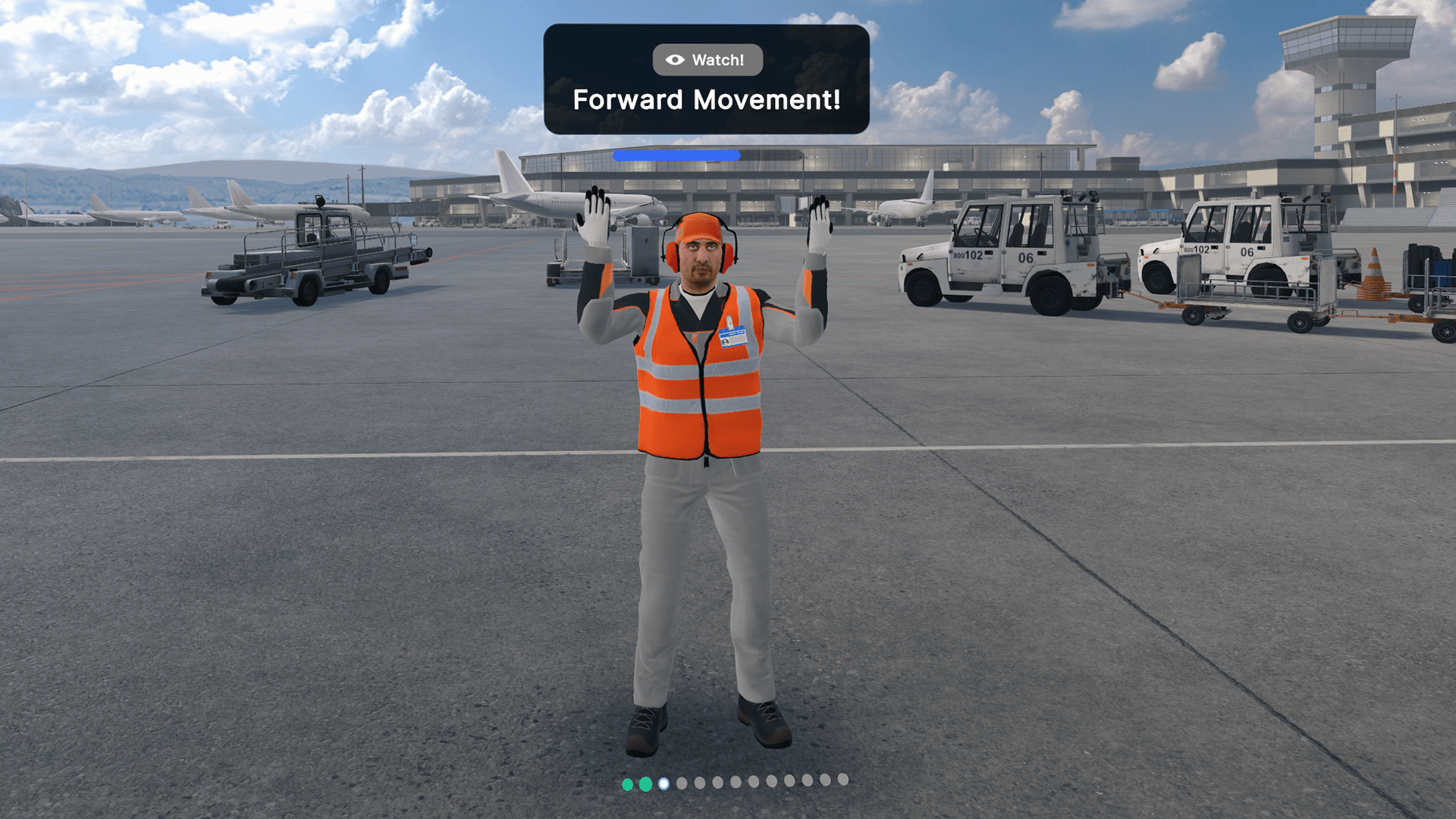
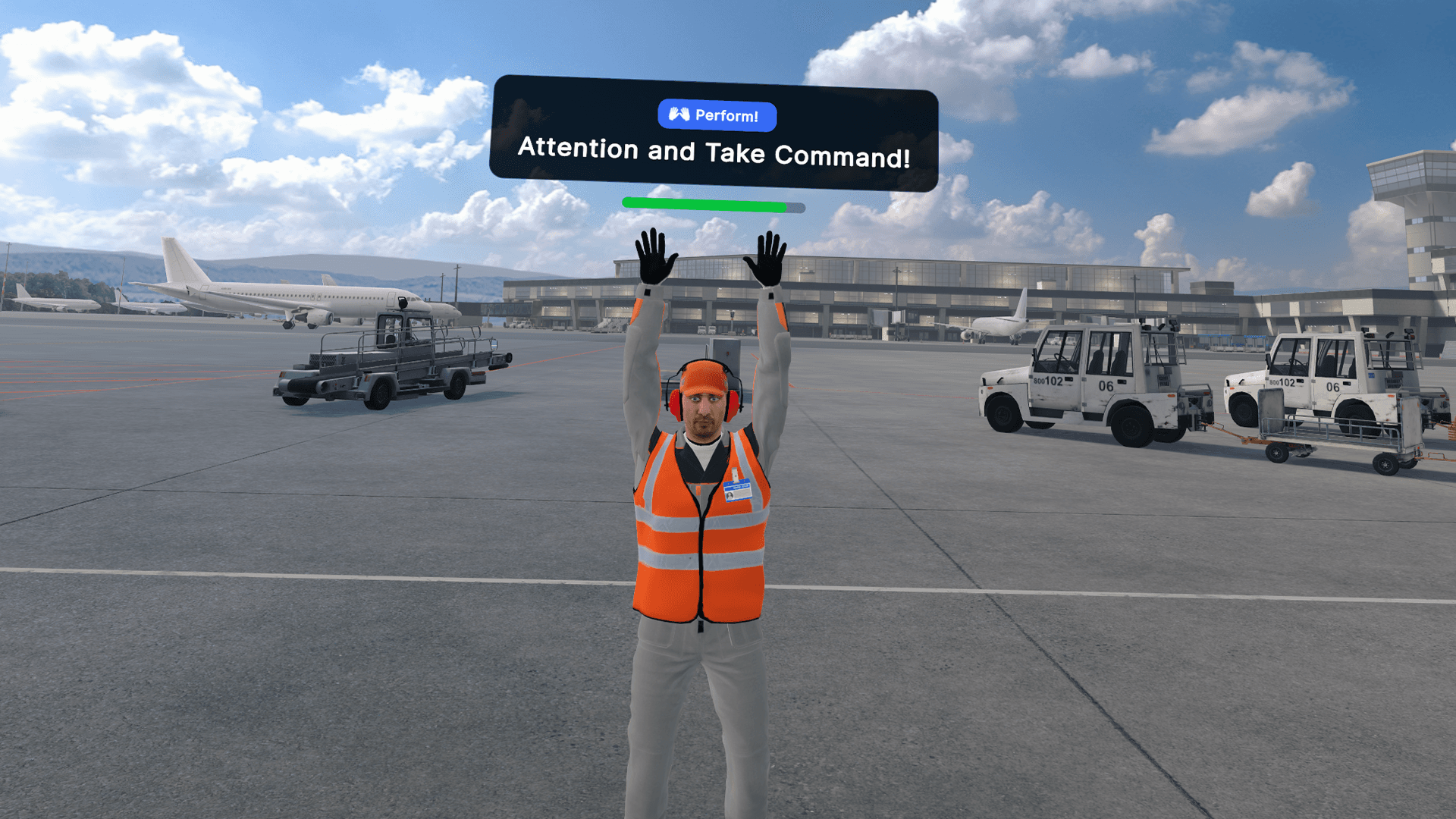
- On the apron, a colleague demonstrates each hand signal, then holds the pose as a live reference while the trainee performs it in real time.
- The 13 signals are practiced in sequence:
- OK
- Negative
- Attention & Take Command
- Forward Movement
- Backward Movement
- Turn Right
- Turn Left
- Lift
- Lower
- Accompanied Movement
- Indicate Distance
- Slow Down
- Stop
- Each signal is held or repeated as required, and can be repeated without re-watching the demonstration.
- Coaching focuses on hand orientation, the direction and speed of movement, and the pose of each hand, and the lesson concludes once all 13 signals have been performed with correct form.
Safety Scenarios & Learnings
Reversed thumb on the OK or Negative signal
Correction; conveys the opposite command.
Correction; conveys the opposite command.
Both hands used for a one-handed signal
Correction; each signal has a form operators rely on.
Correction; each signal has a form operators rely on.
Turn signal performed on the wrong side
Correction; directs the operator to turn the opposite way.
Correction; directs the operator to turn the opposite way.
Signalling without facing the colleague
Reminder; signals must be visible to the person being guided.
Reminder; signals must be visible to the person being guided.
Gallery