 Draxon VR Training Syllabus
VR Training
Marshalling
 Virtual Reality
Description
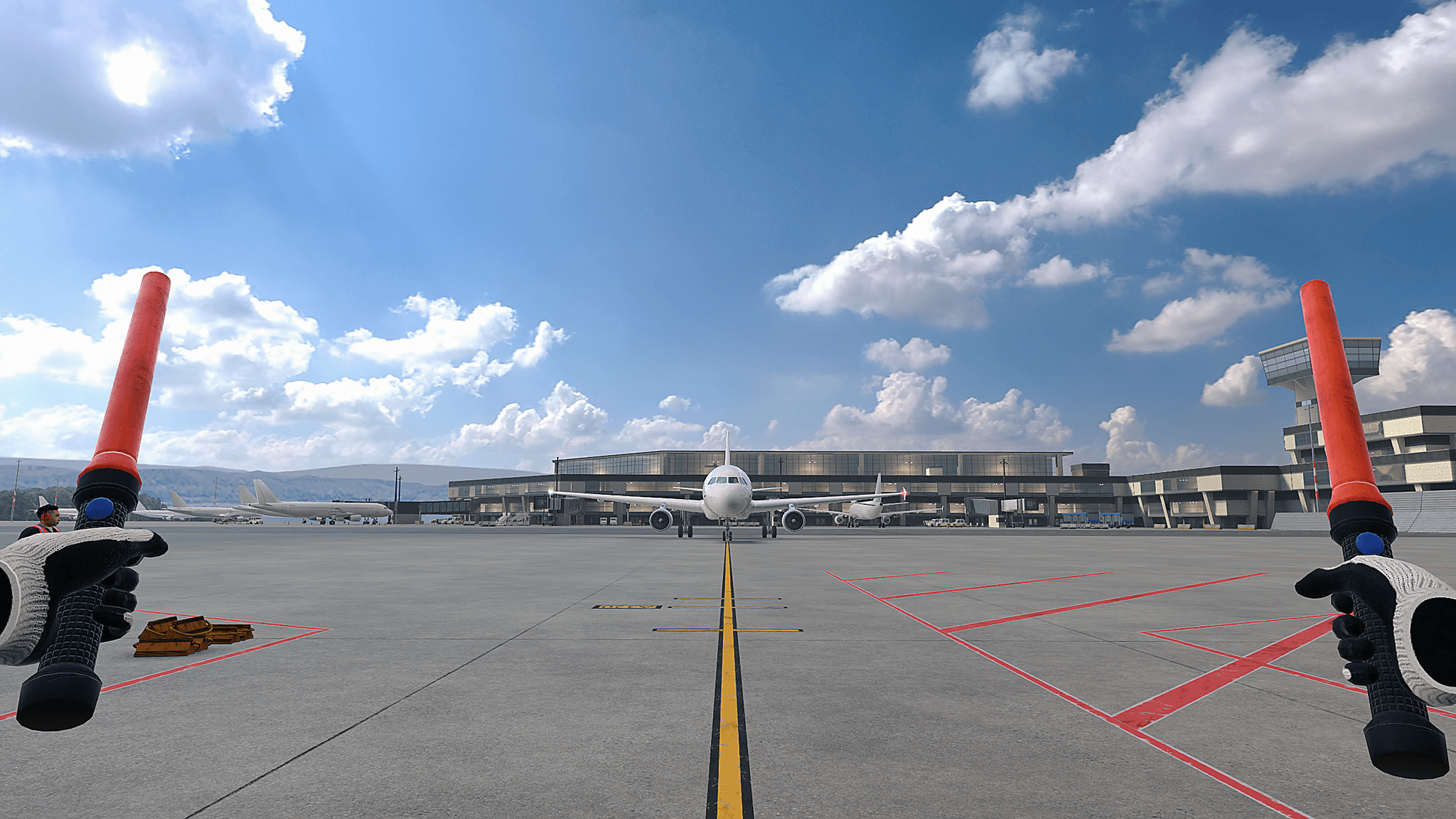
The Marshalling VR Training Course prepares ramp personnel to confidently and safely guide arriving aircraft onto the stand. Trainees learn the standard marshalling signals, then apply them to a complete aircraft arrival, from identifying the gate through to securing the aircraft in its parking position. Built-in error scenarios reinforce signal clarity and timing discipline, because the flight crew acts only on what the marshaller shows. The result is faster qualification, fewer stand incidents, and consistent marshalling standards across stations.
Scope of Course
- Course with 5 lessons across theoretical and practical training; includes a scored assessment of a complete aircraft arrival
- Covers all marshalling operations: stand checks, signal execution, aircraft guidance, stopping, and securing
- Trains the 20 core marshalling signals with motion-detection coaching on every repetition
- Designed for ramp personnel taking on the marshaller role, from new starters to experienced professionals
Languages
English, German, Dutch, Spanish, French, Greek, Arabic, Cantonese Chinese, Turkish
Duration
28 Minutes
Audience
Ground Handling Operators
New Starters & Professionals
Standards
IATA: AHM 1110, Edition 46
IATA: IGOM, Edition 14
Equipment
Reference: Airbus A320
Marshalling wands
Foundational Training
Learning Outcomes
- Establishes understanding of the marshalling role and its responsibility to the flight crew
- Builds recognition and correct execution of the core marshalling signals with the wands
- Trains stand clearance checks for personnel and ground support equipment before any signal is given
- Develops confident marshalling of an arriving aircraft from gate identification through to the parking position
- Ensures precise stop signalling so the aircraft halts on the stop marking for its type, holding clearance to buildings and adjacent stands
- Reinforces immediate stop signalling when a vehicle or person enters the aircraft's path, which the flight crew cannot see from the cockpit
Training Methodology
- Immersive Virtual Reality simulation replicating an active aircraft stand and a live apron arrival
- Realistic wand handling with motion detection assessing arm position, orientation and movement
- Step-by-step guidance with a demonstration before each signal, progressing to unprompted arrivals
- Built-in safety scenarios exposing trainees to late stop signals, misaligned approaches, and aircraft guided off the intended path
- Scored assessment of a full aircraft arrival against defined pass criteria