Draxon VR Training Syllabus
De-icing the Aircraft: Practice
 Virtual Reality
Description
This lesson trains a complete one-step de-icing job on the whole right side of an Airbus A320, carried out by the trainee with help only when needed. Trainees accept the job, de-ice five sections from two working positions in front of and behind the wing, and record the job as done. The focus is on working from the front to the back, from the top down and from the outside in, while keeping the spray off the no-spray zones and the de-icer clear of the aircraft.
Lesson Overview
- 1Introduction to the job: five sections, two working positions and a colleague de-icing the left side
- 2Accept the job, drive to the first working position, and set up the procedure and the fluid
- 3De-ice the front of the fuselage and the right wing from in front of the wing
- 4Reposition the de-icer behind the wing and de-ice the rear of the fuselage and the tail
- 5Record the job and review the result for time, fluid used, spray order and spray distance
Skills Acquired
- Plan a full-side de-icing job by section and working position, so no part of the aircraft is missed before departure
- Apply the front-to-back, top-down and outside-in order on every section of the aircraft
- Prepare the de-icer for driving, with the cabin facing forward and the telescopic boom fully retracted, to prevent contact with the aircraft
- Maneuver the de-icer around the wing without driving under the aircraft or between the engine and the fuselage
- Balance speed, fluid use and spray distance to the level of an experienced operator
Lesson Procedure
- The trainee starts in the operator cabin on an open stand at minus 1 °C, with the whole A320 covered in snow and a colleague de-icing the left side.
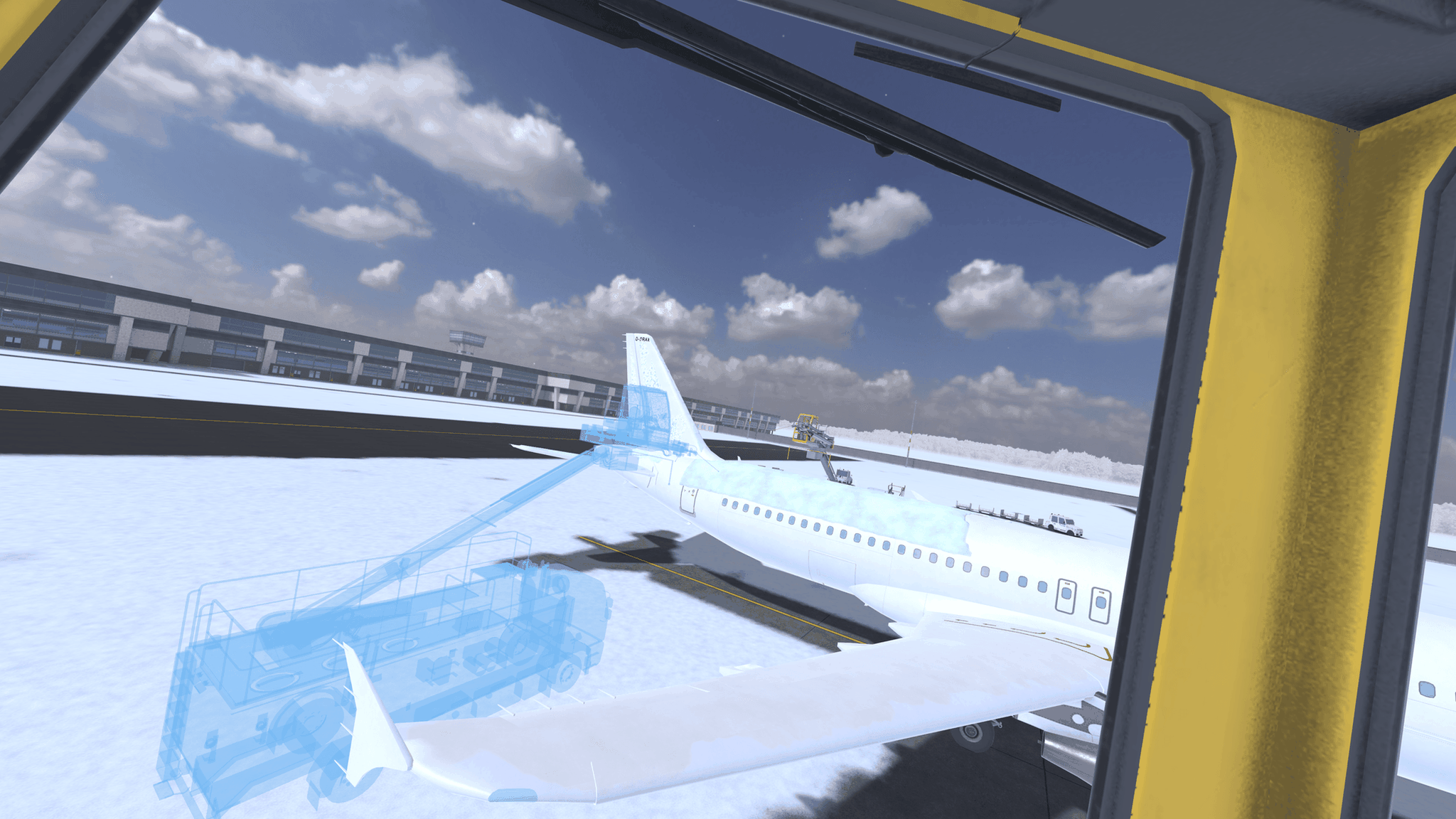
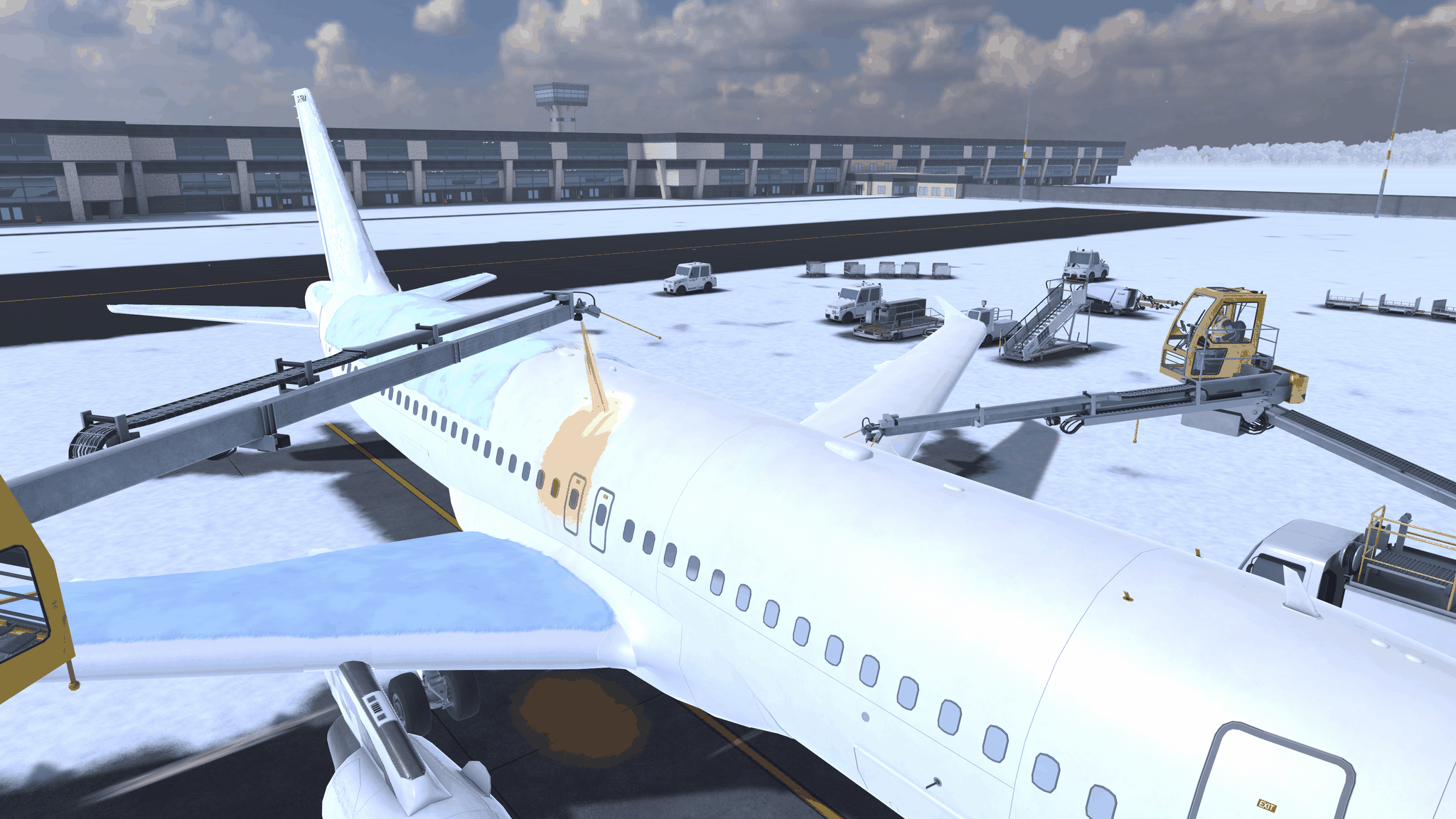
- An overview shows the two working positions and the five sections: the front fuselage and the wing from in front of the wing, then the rear fuselage, the vertical stabilizer and the horizontal stabilizer from behind it.
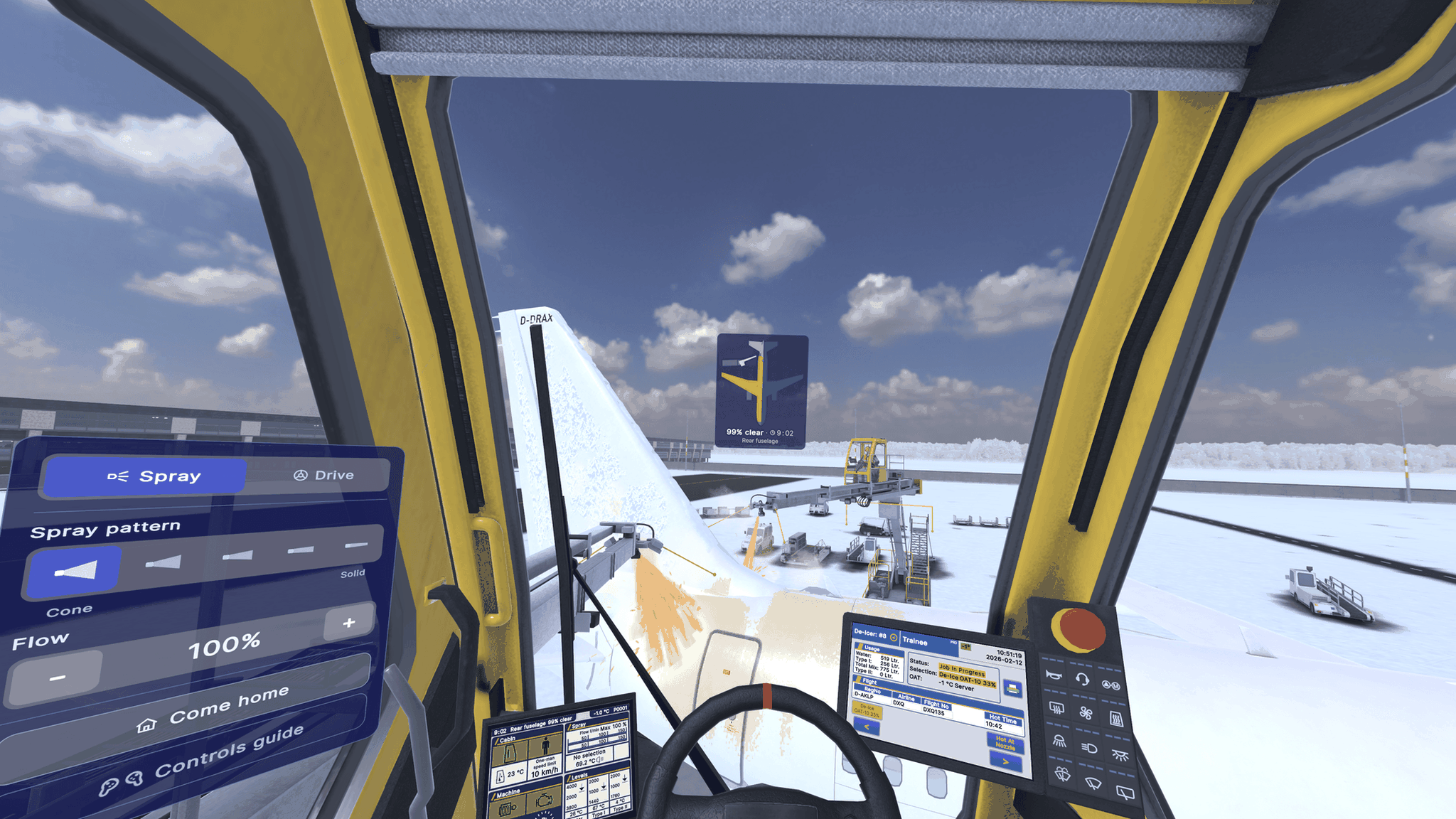
- The trainee accepts the job, drives and steers into the first working position, reports At Location, and selects the one-step procedure and the de-icing fluid. The medium cone and 50 percent flow are recommended, and the spray can be changed at any time.
- The trainee de-ices the front of the fuselage from the front to the back and from the top down, then the wing from the wing tip to the wing root, lowering the cabin and the boom as the wing gets lower.
- Before driving, the trainee turns the cabin forward and fully retracts the telescopic boom, reverses away from the wing and drives to the second working position.
- The trainee clears the rear of the fuselage, the vertical stabilizer from the top down and the horizontal stabilizer from the tip to the fuselage.
- On the task page, the trainee records the fuselage, the right wing, both right stabilizers and the front right and rear right positions, and ends the job.
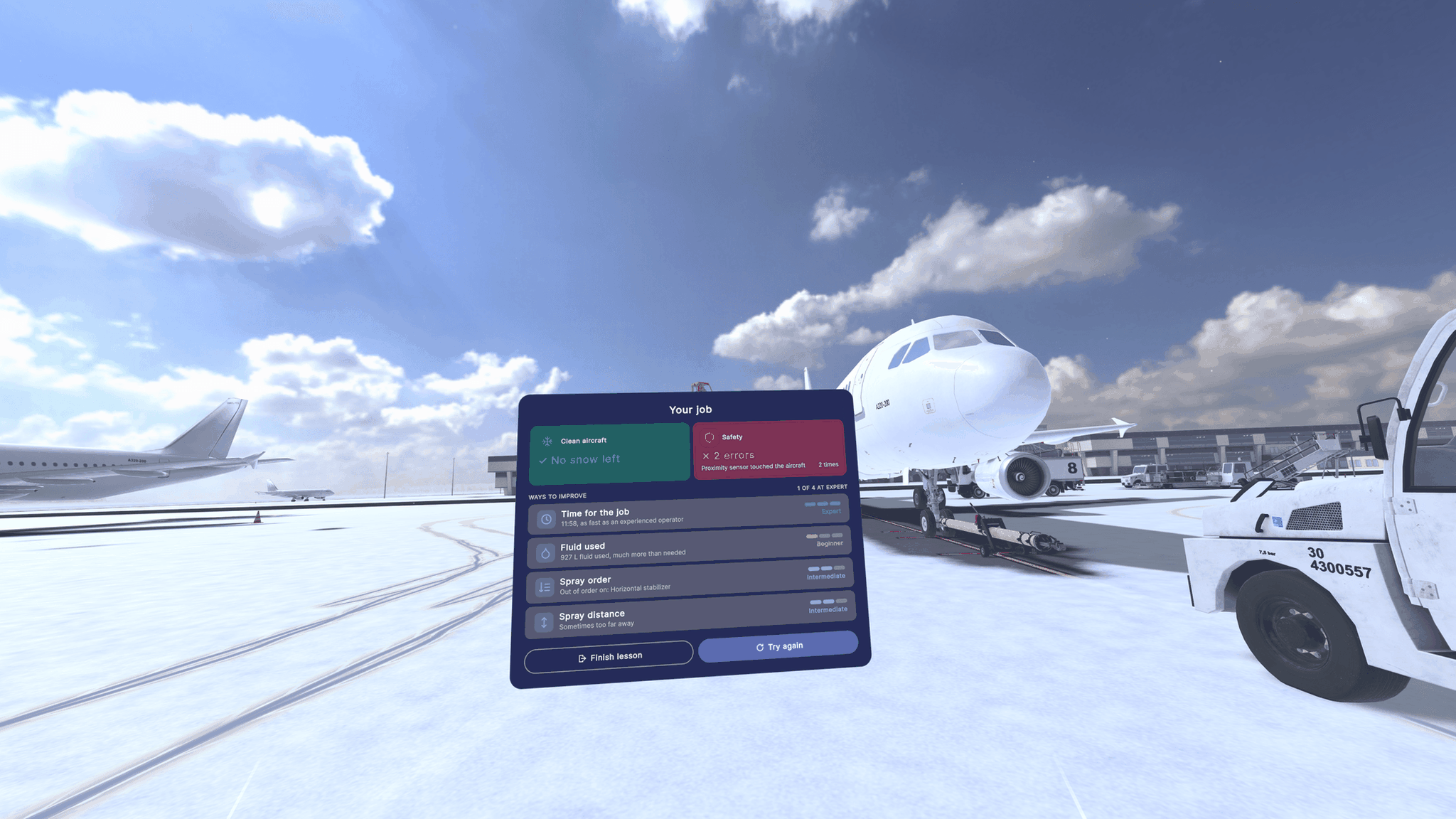
- The result shows whether any snow is left, the safety errors, and a Beginner, Intermediate or Expert level for time, fluid used, spray order and spray distance. Help is given only when the trainee gets stuck, and the job can be repeated as often as needed.
Safety Scenarios & Learnings
Spray directly at the windows, doors or emergency exits
Red error and rewind; spray above them and let the fluid run down
Red error and rewind; spray above them and let the fluid run down
Spray at a sensor on the nose, into the engine inlet or at the auxiliary power unit
Red error and rewind; these are never sprayed directly
Red error and rewind; these are never sprayed directly
Proximity sensor touching the aircraft or the boom hitting it
Error; the boom is moved away from the aircraft
Error; the boom is moved away from the aircraft
De-icer hitting the aircraft, the other de-icer or the pushback tractor
Error; always keep a safe distance
Error; always keep a safe distance
Driving under the aircraft, between the engine and the fuselage, or too close to the wing
Error; the de-icer is moved back
Error; the de-icer is moved back
Driving with the cabin turned or the telescopic boom extended
Warning; turn the cabin forward and retract the boom fully before driving
Warning; turn the cabin forward and retract the boom fully before driving
Driving too far away from the aircraft
Error and rewind; stay inside the stand area
Error and rewind; stay inside the stand area
Gallery