
Passenger Boarding Bridge (PBB)
Passenger boarding bridge operator training in Virtual Reality. Based on IATA AHM RMP06 Ramp Services-Boarding Bridge Operations and IGOM. Covers pre-movement checks, docking at the cabin access door, safety systems and undocking.
What You Will Train
The full boarding bridge cycle, from pre-movement checks and the pre-arrival parking position through docking at the cabin access door to undocking and return to park.
Pre-Movement Checks and Pre-Arrival Position
Serviceability check before use and malfunction reporting. Walking surfaces free of FOD and obstacles. Equipment systems, emergency switches and cut-offs identified in the cab. The bridge fully retracted or in its designated parking position before the aircraft arrives or departs, with the safety barrier in place whenever the bridge is not at the aircraft.
Approach to the Cabin Access Door
Movement only once the aircraft is fully stopped, engines shut down, anti-collision lights off and chocks in place. Movement path confirmed clear of personnel, vehicles and equipment. Safety rails and canopies fully retracted before moving. Slow approach clear of aircraft sensors and protrusions, including the wing root leading edge fairing that extends under certain cabin access doors. A guide person used when the operator's vision is restricted.
Docking and Engagement of Safety Systems
Self-levelling bridges driven until the protective bumpers just touch or the proximity sensors stop movement. Bridges without self-levelling held at a gap under the No-Touch policy. Clearance maintained under the cabin access door, per the door markings, so the door cannot rest on the bridge as the aircraft settles during loading. Safety shoe and auto-leveller engaged, canopy extended, and the controls secured against movement by non-authorized persons.
Undocking, Back Off and Return to Park
Cabin access door confirmed closed before any movement. Integrated ground power cables and pre-conditioned air hoses disconnected from the aircraft first. Rails and canopy retracted, then back off and return to the designated post-departure parking position with the safety barrier reinstated. Wind off, out-of-limit and adverse weather procedures for when the bridge has to be withdrawn from service.
How This Differs From Passenger Stairs
Both operations end at a cabin access door, but the boarding bridge is airport infrastructure with its own geometry, safety systems and failure modes.
Two Opposite Techniques, One Machine
A bridge fitted with a self-levelling device is driven until the protective bumpers just touch the aircraft or the proximity sensors stop it. A bridge without one is held at a gap under the No-Touch policy. The operator has to know which unit they are on, because the wrong habit damages the aircraft.
The Aircraft Moves While You Are Docked
Landing gear struts extend and compress as weight changes during boarding and loading. Clearance under the cabin access door has to be set so the door cannot come to rest on the bridge, and the auto-leveller has to be engaged and confirmed rather than assumed.
Aircraft-Specific Obstructions
IGOM singles out the wing root leading edge fairing that extends under certain cabin access doors, along with sensors and fairings generally. What the operator has to avoid changes with the aircraft type, which is exactly what repetition on one stand does not teach.
The Escape Slide Path Has to Stay Clear
RMP06 lists the emergency slide deployment area as its own topic. A bridge positioned without regard for it compromises the evacuation route of the door it is serving, and the correct position is aircraft-type dependent.
Access Control Is Part of the Task
The RMP06 objective is safe and secure access to the aircraft for authorized persons only. Passenger guidance and surveillance, securing the controls after positioning, unattended aircraft and overnight procedures are all part of the syllabus, not just the drive itself.
Failures Cannot Be Rehearsed Live
Auto-leveller failure, an anti-collision fault, a wind-off decision or an evacuation through the bridge cannot be induced on a real aircraft on a live stand. In VR they can be run repeatedly, which is the point of the module.
Get Notified When This Launches
Passenger Boarding Bridge (PBB) training is currently in development. Leave your details and we will let you know when it becomes available, and which aircraft types and bridge configurations we are prioritizing. Relevant for airport operators as well as ground handlers, since RMP06 is often delivered by the airport authority.
Passenger Boarding Bridges in Context
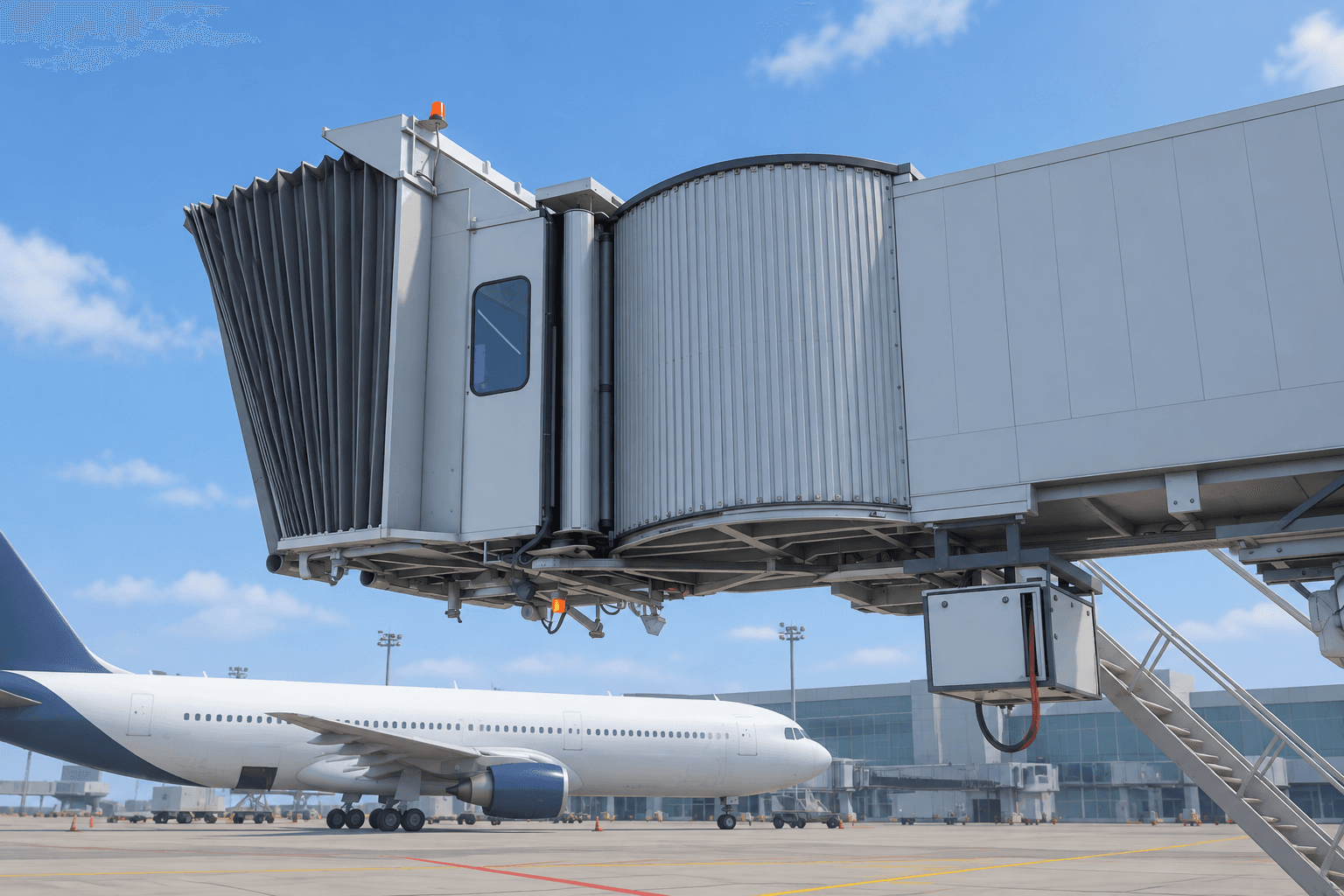
A passenger boarding bridge (PBB) is the enclosed, elevated passageway that connects a terminal gate to an aircraft cabin access door. The same unit is called an airbridge, air bridge, jet bridge, aerobridge, jetwalk, skybridge or finger depending on the region and the operator.
The common configuration is the apron drive bridge: an articulated rotunda anchored at the terminal end, a telescopic tunnel, twin elevation columns, and a powered wheel bogey at the aircraft end. The cab rotates, carries a soft bumper with proximity sensors, and closes onto the door with a canopy or bellows. Other types include the nose loader, used where apron space is restricted, the older fixed pedestal bridge that the aircraft taxis to, and split bridges serving two doors from a single gate, including dual-level configurations for the A380 upper deck.
The standards framework has two layers. IATA AHM RMP06 Ramp Services-Boarding Bridge Operations is the course standard, and its objective goes beyond equipment handling: safe and secure access to the aircraft for authorized persons only. Alongside the drive itself it covers the emergency slide deployment area, adverse weather and out-of-limit conditions, fire drills for both bridge and aircraft, unattended aircraft and overnight procedures. Training and assessment are theoretical and practical, with recurrency within thirty-six months. IGOM provides the procedural detail, and the equipment itself is built to EN 12312-4:2024.
RMP06 does not stand alone. Published prerequisites include GEN, RMP01 wing walking, RMP04 basic hand signals, RMP08 aircraft cabin access doors and RMP10 aircraft arrival. A bridge qualification does not carry the authority to open an aircraft door, which is separate training. Bridge-mounted ground power and pre-conditioned air sit under RMP14, even though both are physically part of the bridge. Because the bridge is usually airport infrastructure, RMP06 is often delivered by the airport authority rather than the handler.
Ground damage is why this matters commercially. IATA puts the cost of aircraft ground damage at roughly five billion US dollars a year, with a projection approaching ten billion by 2035 without preventive action. The Swiss Federal Office of Civil Aviation reported that for 2023, ground damage reports rose twenty-seven per cent year on year, and that eighty per cent of damage occurred during container loading or during the docking phase of a passenger boarding bridge or passenger stairs.
The bridge is also unusually hard to train on. It is airport infrastructure on a live stand, so practice competes directly with commercial turnarounds, and there is no non-live way to rehearse a docking. The situations that matter most, an auto-leveller that fails to engage, an anti-collision fault, the door settling onto the bridge as the gear compresses, a wind-off decision or an evacuation, are precisely the ones that cannot be induced on a real aircraft. Virtual Reality lets an operator run the full cycle, including the failures, as often as needed before they touch a real bridge.
Good to know
When will the Passenger Boarding Bridge training be available?
We are currently in development. Leave your email in the form above and we will let you know as soon as it becomes available.
Which IATA standard does boarding bridge training fall under?
IATA AHM RMP06 Ramp Services-Boarding Bridge Operations. Its eighteen topics run from pre-movement checks and positioning through safety systems, the emergency slide deployment area, adverse weather, fire drills and incident reporting. Training and assessment are both theoretical and practical, and recurrent training or assessment is required within thirty-six months. Published prerequisites include GEN, RMP01 wing walking, RMP04 basic hand signals, RMP08 aircraft cabin access doors and RMP10 aircraft arrival. The procedural detail sits in IGOM 3.1.3.5, and the equipment standard is EN 12312-4:2024.
Does boarding bridge training cover opening the aircraft door?
No. Operating the bridge and operating the cabin access door are separate authorisations. A bridge qualification does not carry the authority to open an aircraft door, which falls under RMP08 Aircraft Cabin Access Doors. The bridge operator's responsibility is the clearance under the door and confirming the door is closed before undocking.
Which aircraft and bridge types will be covered first?
The first release is scoped to the Airbus A320 family on an apron drive bridge. Further aircraft types, wide-body multi-bridge sequencing and other bridge configurations will be prioritized by customer demand. Tell us what you need through the form above and it will feed directly into that decision.
Does the training cover bridges without an auto-leveller?
This is a real difference in procedure, not a variation in equipment. A bridge with a self-levelling device is driven until the bumpers just touch the aircraft or the proximity sensors stop it. A bridge without one is docked to a gap under the No-Touch policy, and IGOM requires it to be attended by an operator the whole time it is positioned at an aircraft. Handlers and airports with mixed fleets need both, and scope for the first release will reflect what customers tell us they operate.
What is the difference between a passenger boarding bridge and passenger stairs?
Both end at a cabin access door, but the bridge is fixed at the terminal end and moves within the geometry of its rotunda and travel path, whereas stairs are positioned freely on the apron. The bridge levels itself against the aircraft as the gear compresses during loading, encloses the passenger flow, often carries integrated ground power and pre-conditioned air, and can require multi-bridge sequencing on wide-body stands. It is also airport infrastructure operated under an airport permit rather than handler-owned equipment.
Will bridge-mounted ground power and pre-conditioned air be included?
Those sit under RMP14 GSE Operations rather than RMP06, and they have been requested separately by handlers and airports. The bridge module covers the operator's duty to stow cables and hoses before movement and to confirm they are disconnected from the aircraft before undocking. Whether we build the full FEGP and PCA content depends on demand, so let us know through the form.
Is a guide person needed to position a boarding bridge?
IGOM 3.1.3.5 requires a guide person when the driver or operator's vision is restricted while positioning the bridge at the cabin access door, and RMP06 lists signals for positioning and removal of the bridge as part of the syllabus. That makes basic hand signals a directly related skill.
Can this be used for both initial and recurrent training?
Yes. RMP06 requires recurrent training or recurrent assessment within thirty-six months, and some operators work to shorter intervals. Because a headset session does not need a live stand or a real aircraft, recurrency can be run without taking a bridge out of service.
Why use VR for boarding bridge training?
Practice on a real bridge competes with commercial turnarounds, and the situations that cause damage cannot be staged on a live aircraft. Regulators put bridge docking in the same bracket as container loading as a source of ground damage: the Swiss Federal Office of Civil Aviation reported that eighty per cent of ground damage in 2023 occurred during container loading or during the docking phase of a boarding bridge or passenger stairs. VR lets an operator repeat the full cycle, including auto-leveller failure, out-of-limit conditions and evacuation, before they touch a real bridge.