Draxon VR Training Syllabus
Pre-departure Walkaround Check (Practice)
 Virtual Reality
Description
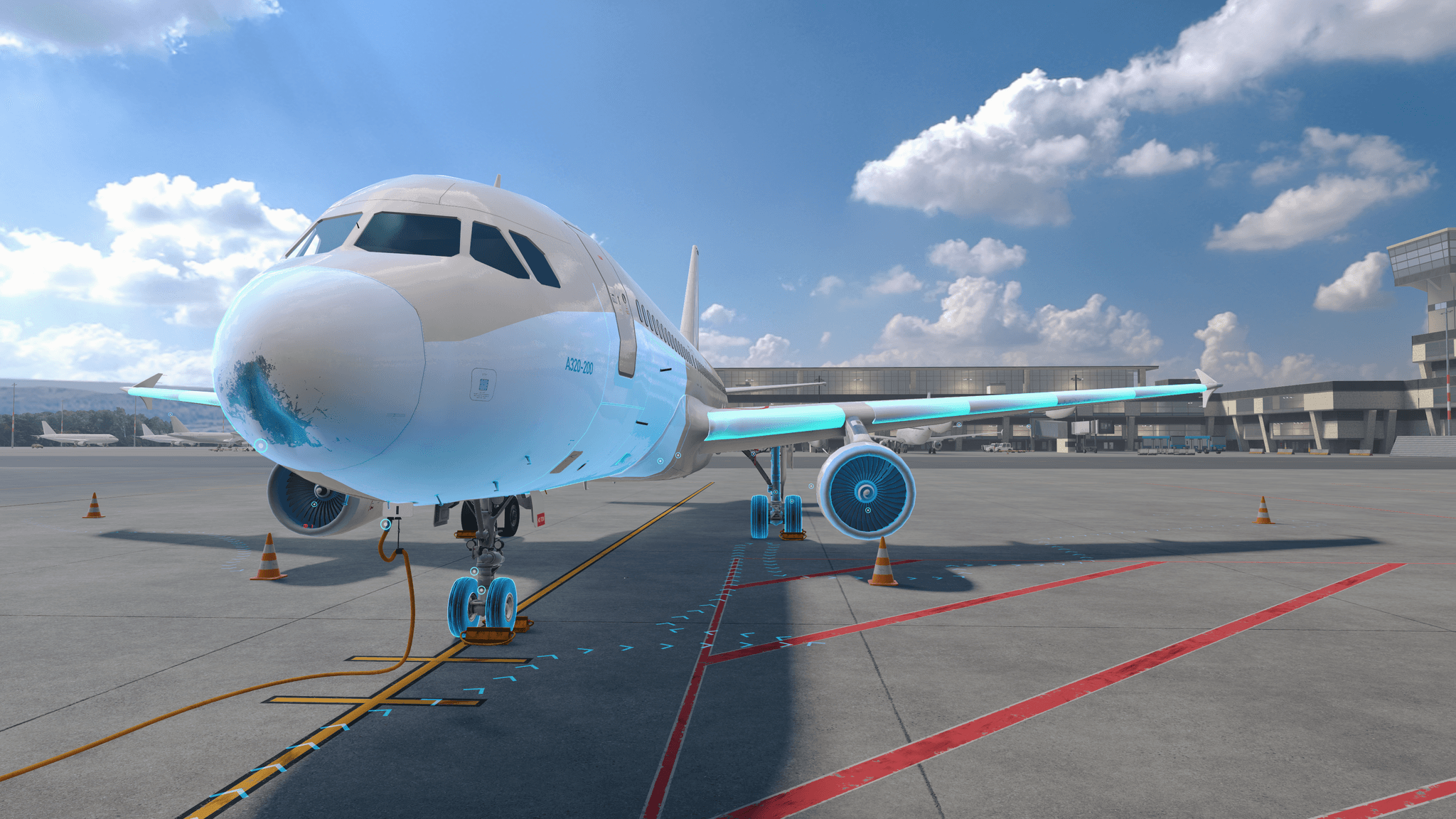
This lesson has trainees walk the pre-departure route on the Airbus A320 on their own and judge every inspection point themselves. The practice covers the same counter-clockwise circuit on a departure-ready aircraft, with faults planted at randomized points and in greater numbers than a real aircraft would carry. Trainees build the judgment to tell a genuine fault from normal wear or an opening that is meant to sit open, and to report when unsure.
Description
This lesson has trainees walk the pre-departure route on the Airbus A320 on their own and judge every inspection point themselves. The practice covers the same counter-clockwise circuit on a departure-ready aircraft, with faults planted at randomized points and in greater numbers than a real aircraft would carry. Trainees build the judgment to tell a genuine fault from normal wear or an opening that is meant to sit open, and to report when unsure.
Lesson Overview
- 1Introduction to the practice format and the in-order or faulty decision required at every inspection point
- 2Nose, nose landing gear and left forward fuselage
- 3Left main gear, engine and wing
- 4Tail, rear fuselage and the cargo and service doors
- 5Right wing, engine, main gear and right forward fuselage
- 6Re-inspect after a wrong call and complete the route with a report to the cockpit
Skills Acquired
- Judge each part of a departure-ready aircraft on its actual condition rather than its expected condition
- Tell a genuine fault from normal tread wear, a paint scratch or an opening that is meant to sit open
- Recognize the faults that are easiest to miss, including panels underneath the fuselage and doors on the service side
- Decide when to report on uncertainty, weighing an unnecessary report against a missed fault
- Understand the safety significance of the pre-departure check as the last inspection before the aircraft is cleared to move
Lesson Procedure
- The trainee starts in front of a departure-ready A320 at the stand, boarding complete and all ground equipment except the GPU removed, and works the same counter-clockwise route as the guided lesson without being told what to look for.
- At each inspection point the trainee looks the area over and chooses In order or Faulty; a wrong call prompts another look before the route continues.
- Nose area: the radome, which may be heavily damaged, and the forward antennas, one of which may be broken.
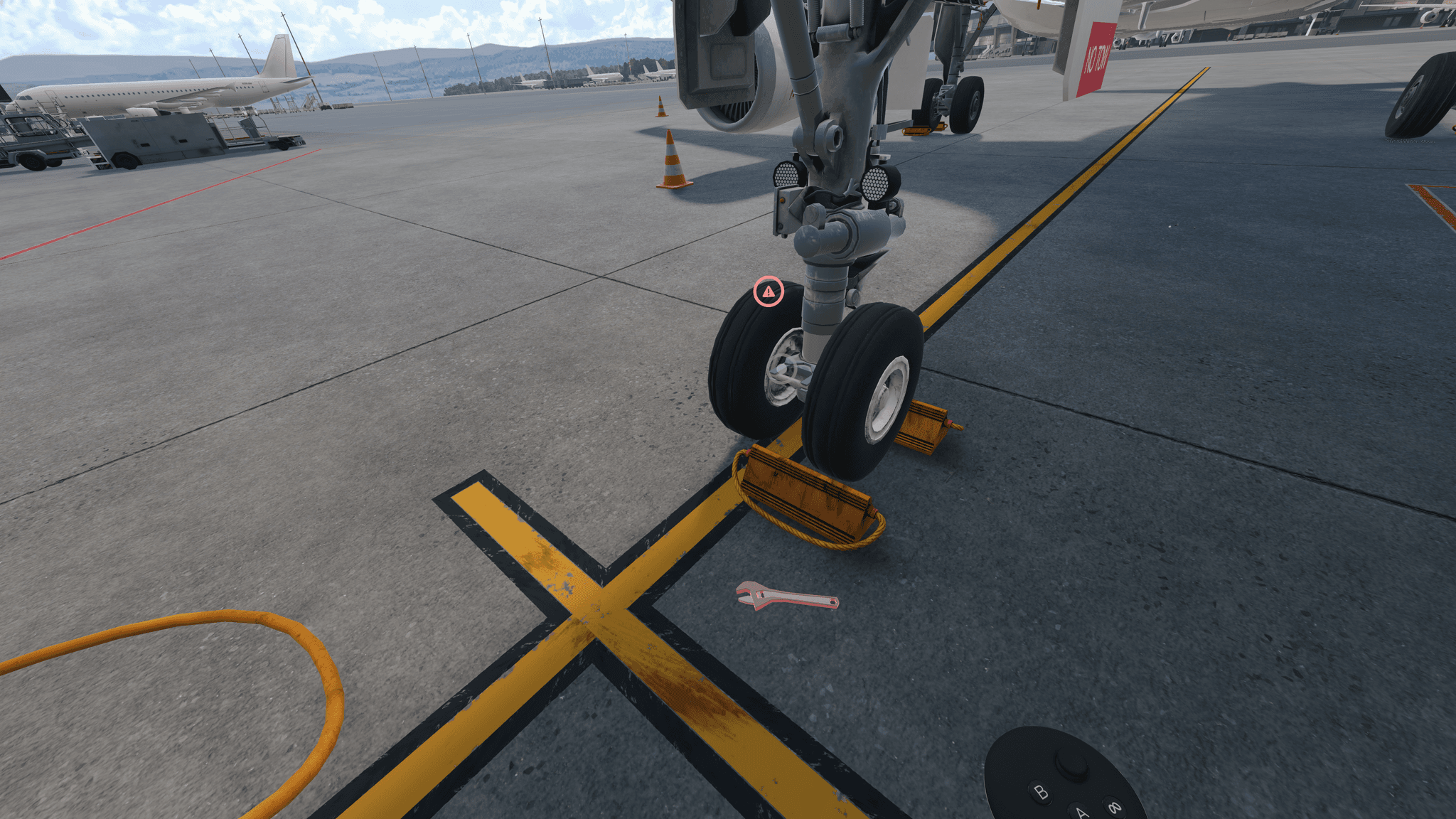
- Nose landing gear: the ground checked for F.O.D. such as a wrench left by the gear and for hydraulic leaks; the tires checked for a crack running across the grooves against even tread wear.
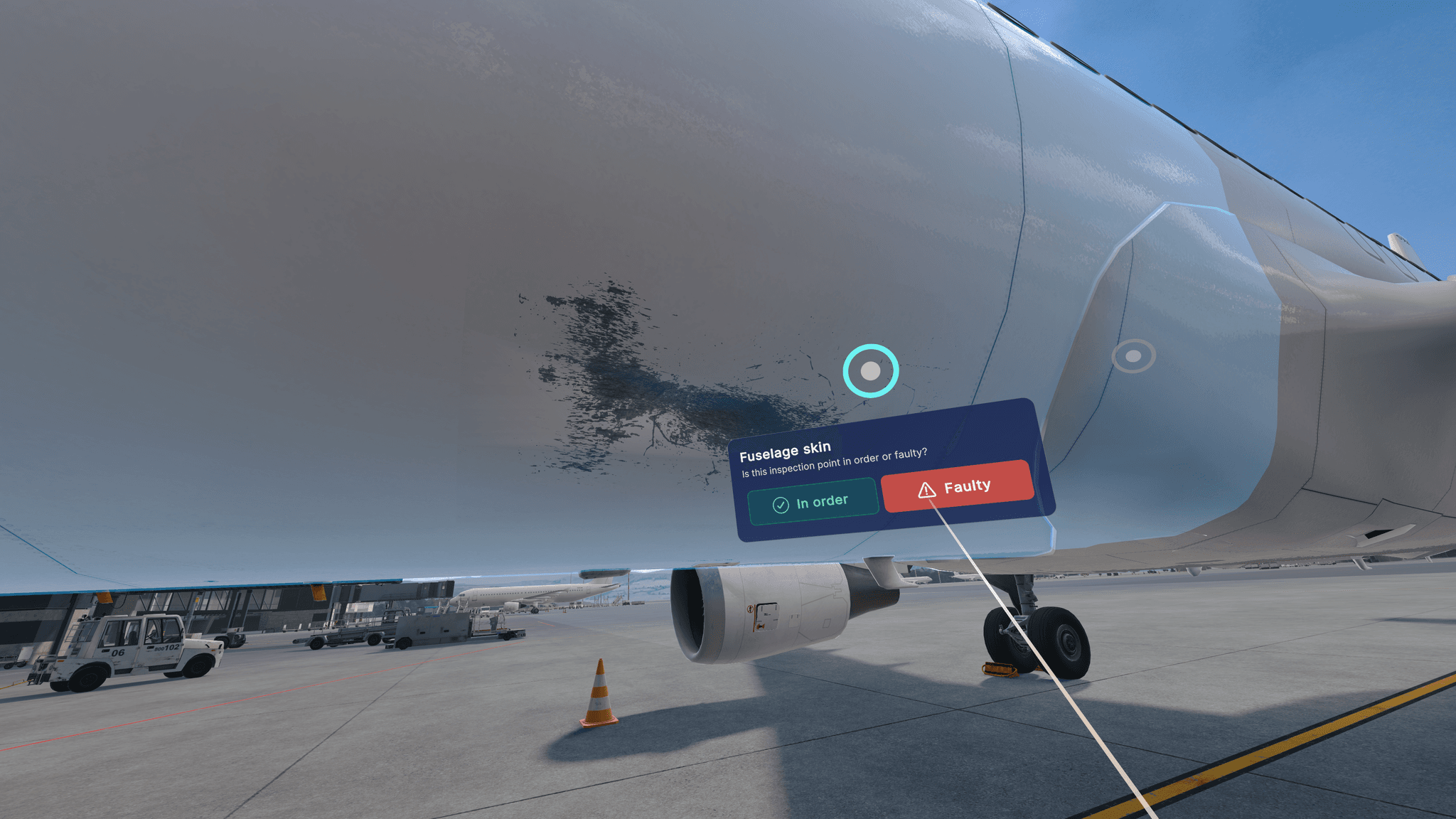
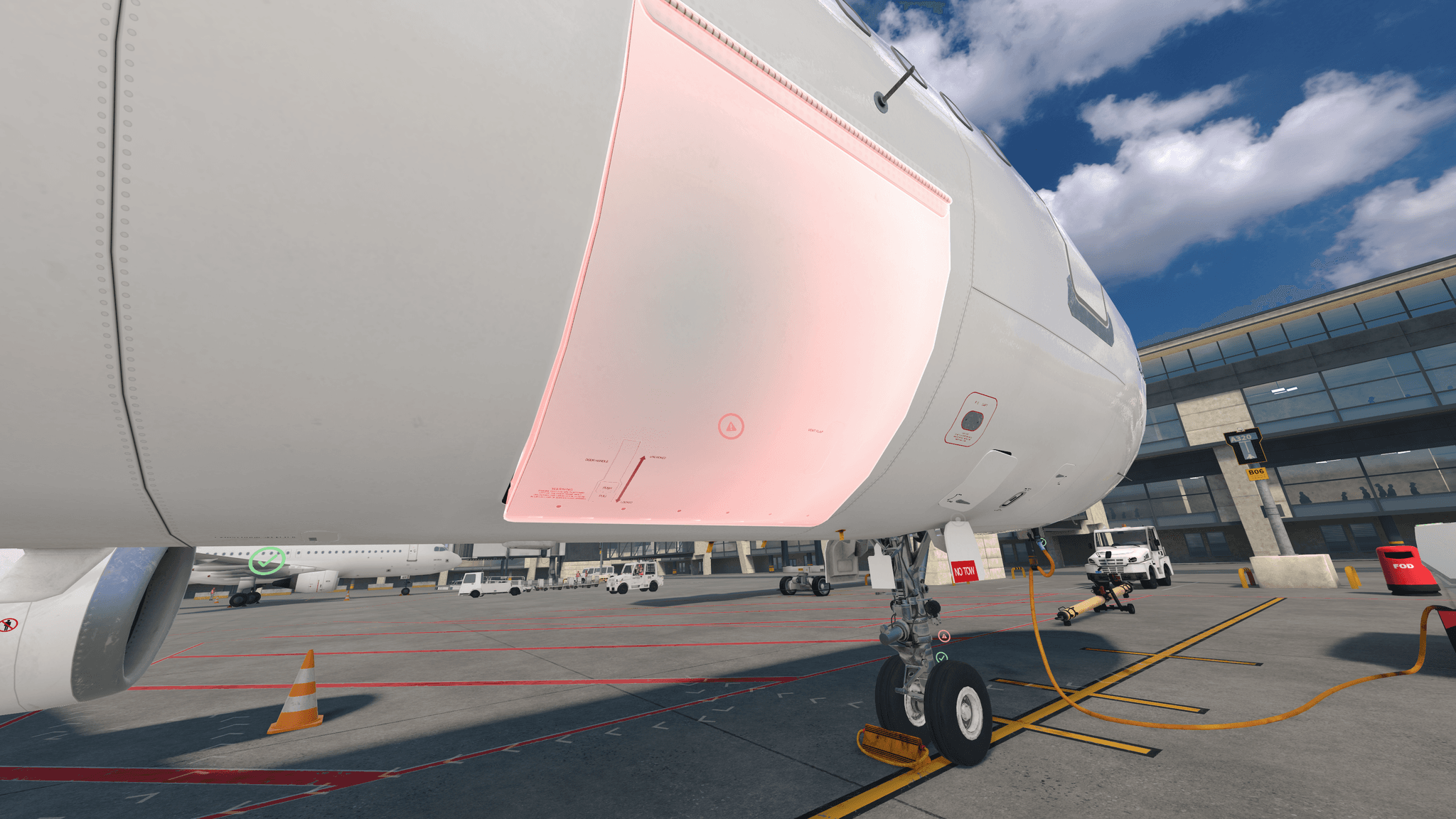
- Left forward fuselage: forward passenger door not properly closed, an access panel left open, major damage to the fuselage skin, and screws missing and lying on the ground.
- Air outlet: open or closed are both normal, so there is nothing to report.
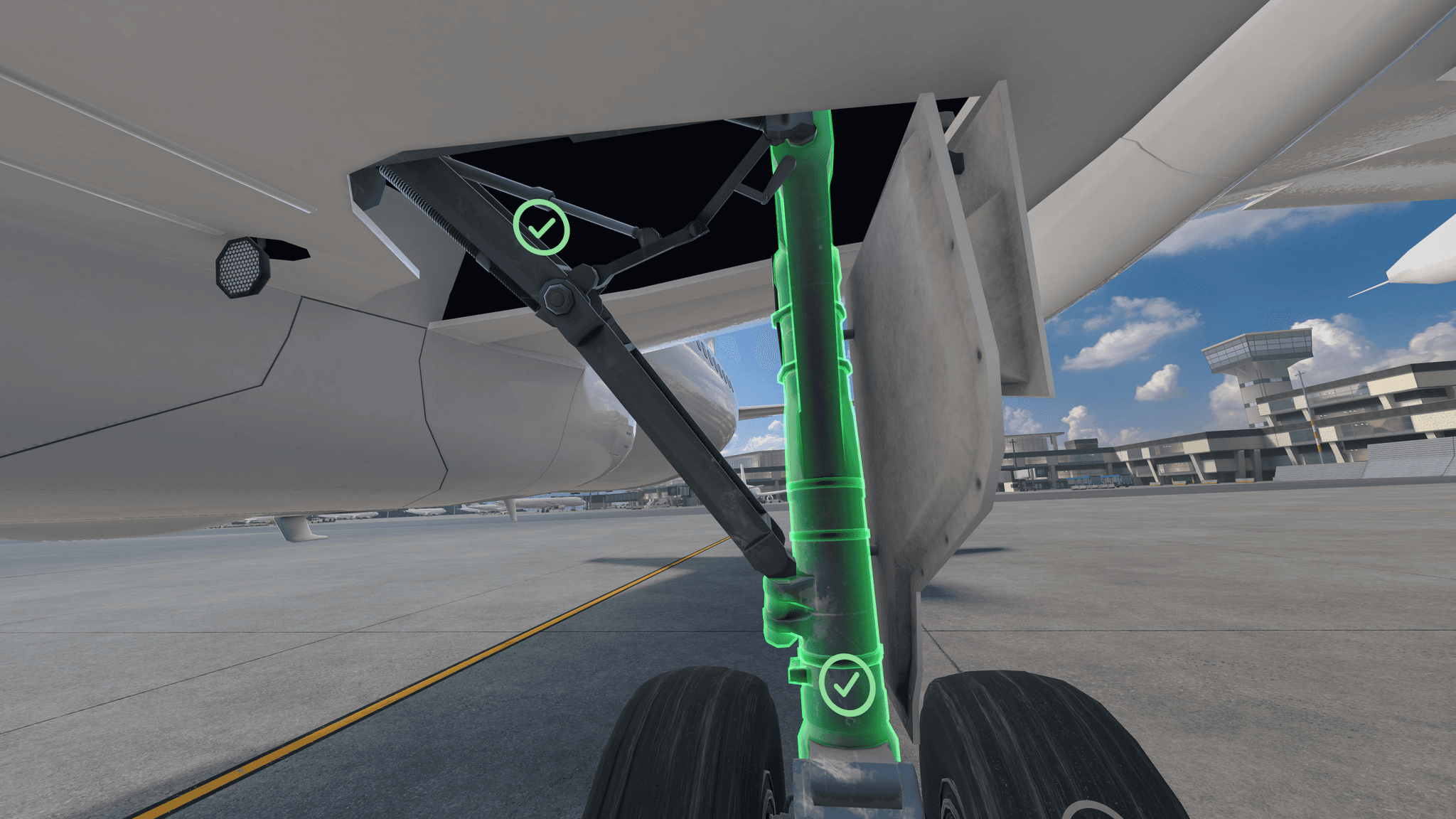
- Left main gear: tires with a transverse crack, hydraulic fluid running down the strut, and a safety pin still attached so the gear cannot retract.
- Left engine: oil-fill panel not properly closed, the side access panel left open, and multiple fan blades damaged inside the intake.
- Left wing: damaged leading edge, refuel panel left open, damaged winglet, and damaged static dischargers on the trailing edge.
- Left rear fuselage: belly-fairing access panel left open, rear-left passenger door not sitting flush, and the potable-water service panel left open.
- Tail: damage to the fin, the stabilizers, the tail cone or the trailing-edge dischargers.
- Right rear fuselage: rear-right service door not properly closed, toilet-service panel left open, bulk and rear cargo doors not closed fully, the rear cargo door selector left open after loading, and a belly-fairing panel left open.
- Right wing: damaged static dischargers, damaged winglet, damaged leading edge, and refuel panel left open.
- Right engine and main gear: the access panel on the outboard side left open, the oil-fill panel left open, a headset left inside the intake, a deep cut in a tire, hydraulic fluid on the strut mount, and a safety pin still attached.
- Right forward fuselage: wing-box fuel panel left open, a front access panel left open, the forward cargo door selector left open, the forward cargo door not fully closed, and the air inlet, which is normal either way.
- Parking-brake light: the trainee presses the button on the steering bypass pin housing first, then judges whether the light came on.
- The forward-right service door completes the route, checked for a door not sitting flush against the fuselage.
- The lesson closes with the reminder that a real aircraft rarely carries this many faults, that a clean walkaround is still reported to the cockpit, and that anything suspicious is reported rather than ignored.
Safety Scenarios & Learnings
Damage to the airframe
Reinforces that a fresh dent, crack or cut must be reported, while a paint scratch, normal wear or a logged mark must not.
Reinforces that a fresh dent, crack or cut must be reported, while a paint scratch, normal wear or a logged mark must not.
Panels, doors or selectors left open after the turnaround
Reinforces that the points underneath the fuselage and on the service side are the easiest on the route to miss.
Reinforces that the points underneath the fuselage and on the service side are the easiest on the route to miss.
Main gear safety pin still attached
Demonstrates that the gear cannot retract after take-off while the pin is in place.
Demonstrates that the gear cannot retract after take-off while the pin is in place.
F.O.D. left by the gear or inside an engine intake
Reinforces that a tool by the gear can damage the tires during pushback, and a headset in an intake is drawn into the engine at start-up.
Reinforces that a tool by the gear can damage the tires during pushback, and a headset in an intake is drawn into the engine at start-up.
Tire cracks, fluid leaks or missing hardware
Shows that a crack across the grooves, hydraulic fluid on a strut or a missing screw or discharger is as reportable as visible damage, while even tread wear is not.
Shows that a crack across the grooves, hydraulic fluid on a strut or a missing screw or discharger is as reportable as visible damage, while even tread wear is not.
Air outlet or inlet reported as faulty
Reinforces that a few openings are normal either open or closed, and an unnecessary report costs the cockpit time.
Reinforces that a few openings are normal either open or closed, and an unnecessary report costs the cockpit time.
Gallery