Draxon VR Training Syllabus
Pre-departure Walkaround Check (Assessment)
 Virtual Reality
Description
This assessment verifies that the trainee can perform the complete pre-departure walkaround on the Airbus A320 without guidance. The trainee walks the counter-clockwise route on a departure-ready aircraft with faults planted at some but not all inspection points, and commits a final verdict at each one with no feedback until the assessment is submitted. Scoring covers the thoroughness of the inspection, the accuracy of every call, and the discipline of the walkaround itself.
Description
This assessment verifies that the trainee can perform the complete pre-departure walkaround on the Airbus A320 without guidance. The trainee walks the counter-clockwise route on a departure-ready aircraft with faults planted at some but not all inspection points, and commits a final verdict at each one with no feedback until the assessment is submitted. Scoring covers the thoroughness of the inspection, the accuracy of every call, and the discipline of the walkaround itself.
Lesson Overview
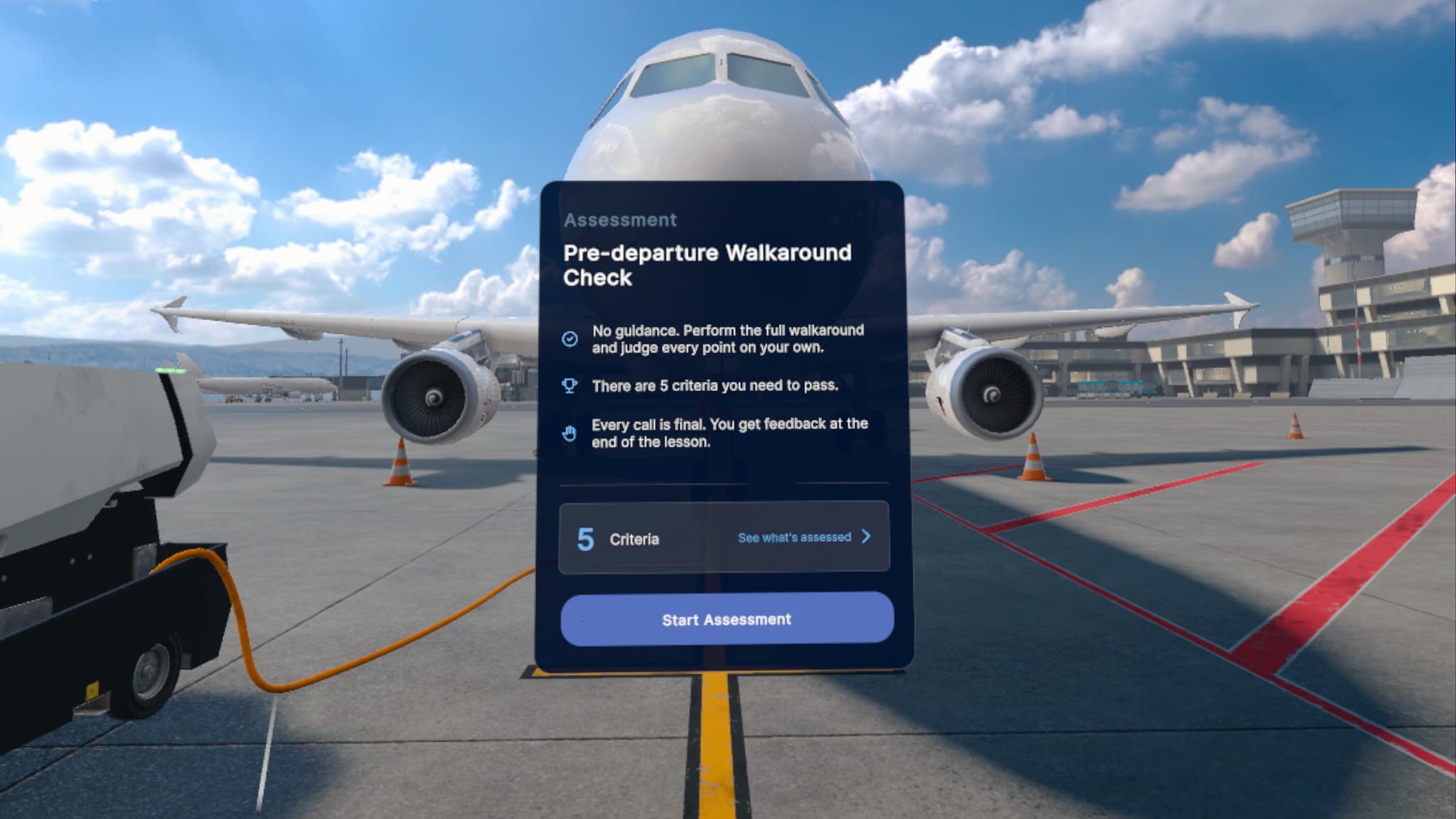
- 1Introduction to the assessment format: no guidance, every call final, and five criteria that must all be passed
- 2Inspect every point of the walkaround, following the path counter-clockwise around the outside of the aircraft from the nose
- 3Identify every fault on the aircraft and report every part that is in order as in order
- 4Test the parking-brake light before judging whether it works
- 5Submit from the exit area and review the passed and missed criteria
Skills Acquired
- Perform the full pre-departure walkaround unaided, from the first point at the nose to the last on the service side
- Commit to a verdict on each part without feedback or a second attempt, as on a live departure
- Report every part that is in order as in order, so the findings reaching the cockpit are only the real ones
- Understand the safety significance of the pre-departure check as the last inspection before the aircraft is cleared to move
Lesson Procedure
- The trainee starts in front of a departure-ready A320 with no guidance: the full walkaround is performed independently, and the exit area for submitting is pointed out at the start.
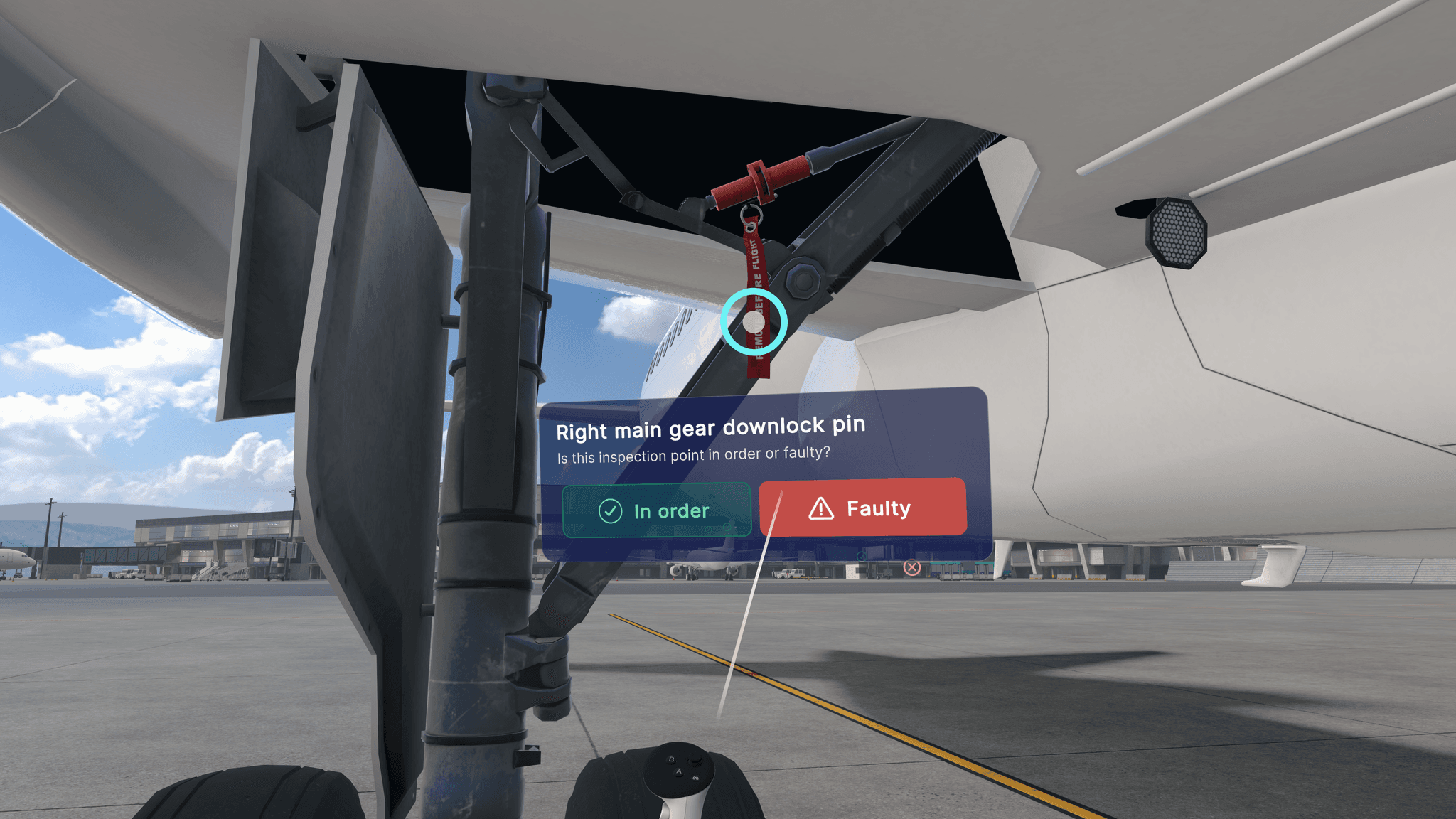
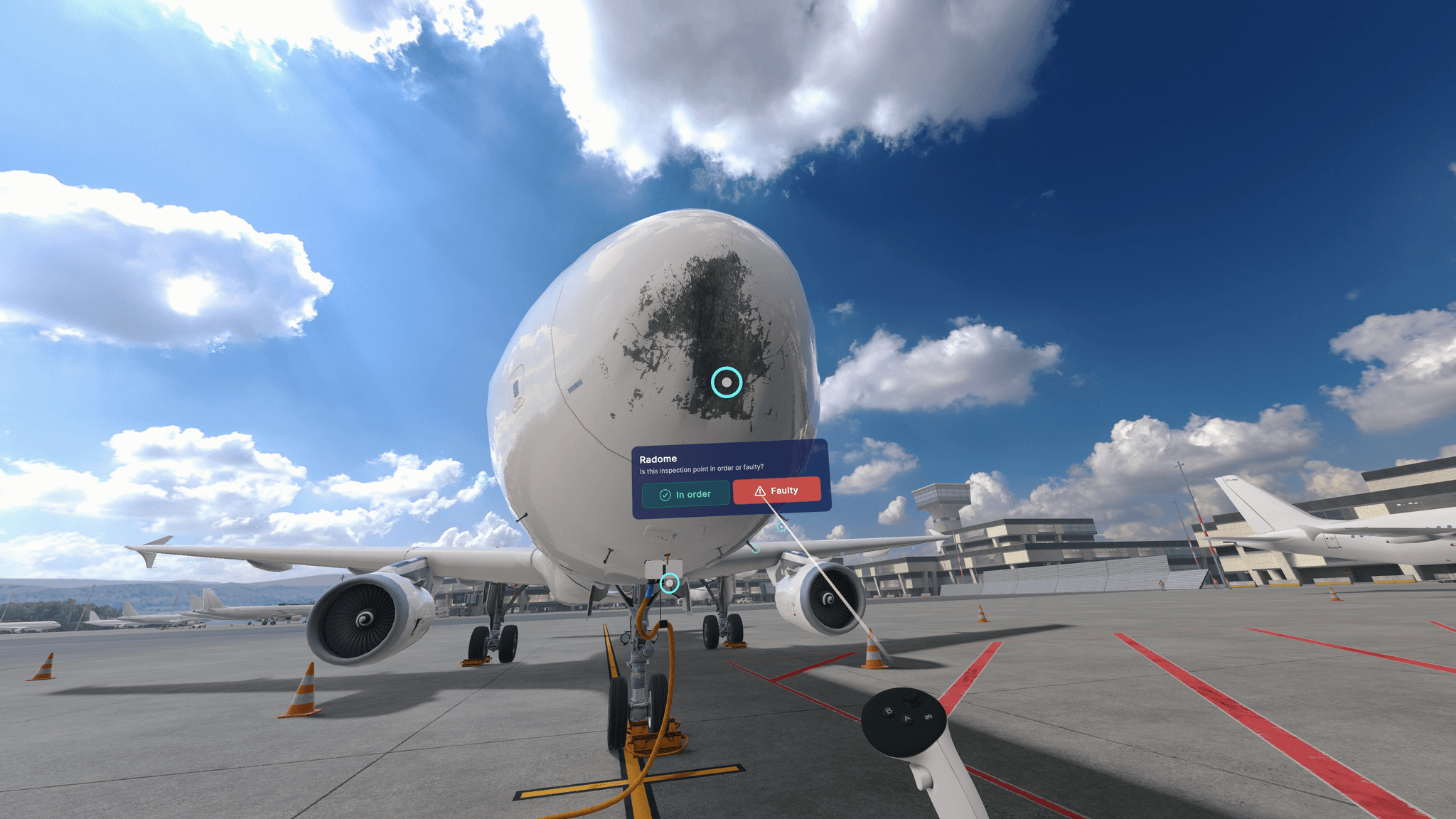
- At each inspection point the trainee gives a verdict of In order or Faulty. The call is recorded and cannot be changed, and no feedback is given during the assessment.
- The assessed points cover the same route as the guided and practice lessons: radome, antennas, nose landing gear area and nose gear tires.
- Forward passenger door, access panels, air outlet, fuselage skin and screws on the left forward fuselage.
- Left main gear safety pin, tires and strut; left engine access panels and intake.
- Left wing leading edge, refuel panel, winglet and static dischargers; left belly-fairing access panels; rear-left passenger door; potable-water service panel.
- Tail section; rear-right service door; toilet-service panel; bulk cargo door, rear cargo door and its selector; right belly-fairing access panels.
- Right wing static dischargers, winglet, leading edge and refuel panel; right engine intake and access panels; right main gear tires, strut and safety pin.
- Wing-box fuel panel, right front access panels, forward cargo door and its selector, air inlet, parking-brake light and the forward-right service door.
- Once every point has a verdict, the trainee walks into the exit area and submits. The walkaround cannot be resumed afterwards.
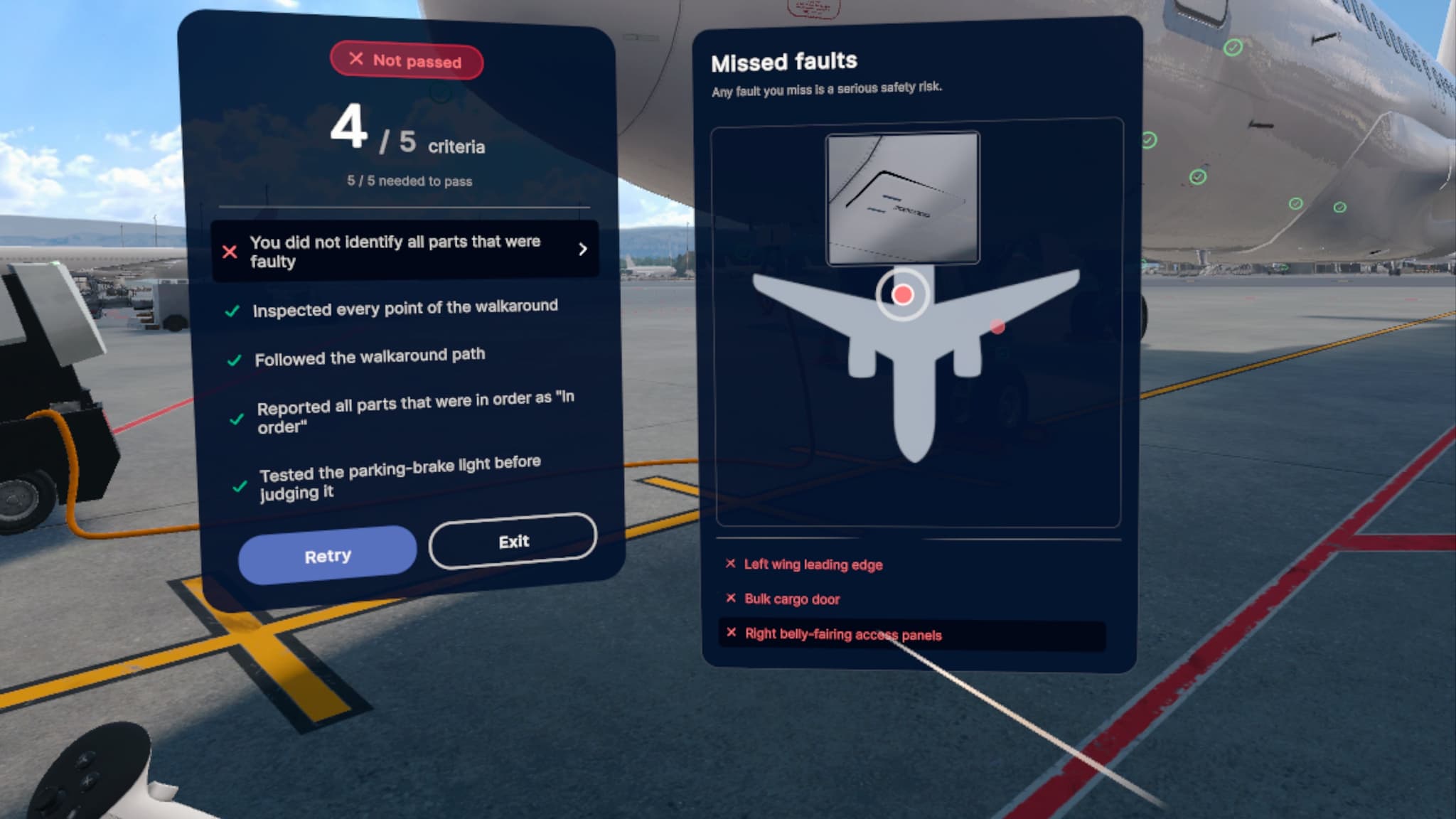
- The assessment is scored against five criteria and the trainee is shown which passed and which were missed, including the points never inspected, whether the walkaround path was followed, the faults marked in order, and the false reports.
- Anything short of five of five is not a pass, and the trainee walks the full route again.
Safety Scenarios & Learnings
Inspection points left without a verdict
Reinforces that every point has to be judged before the aircraft can be cleared for departure.
Reinforces that every point has to be judged before the aircraft can be cleared for departure.
Walkaround path not followed
Highlights that the path runs counter-clockwise around the outside of the aircraft from the nose, with each area checked one after the other so that nothing is left out.
Highlights that the path runs counter-clockwise around the outside of the aircraft from the nose, with each area checked one after the other so that nothing is left out.
Faulty part marked as in order
Demonstrates that the walkaround is the last inspection before departure, so a missed fault reaches nobody else and the aircraft flies with damage.
Demonstrates that the walkaround is the last inspection before departure, so a missed fault reaches nobody else and the aircraft flies with damage.
A part that is in order reported as faulty
Shows that even one false report leaves the cockpit unable to tell real findings from the rest.
Shows that even one false report leaves the cockpit unable to tell real findings from the rest.
Parking-brake light judged without being tested
Reinforces that the light has to be pressed before there is anything to judge.
Reinforces that the light has to be pressed before there is anything to judge.
Gallery