
Lower Deck Loader (LDL)
Lower Deck Loader operations training in Virtual Reality. Based on IATA AHM RMP14 Ramp Services-GSE Operations and RMP09 Aircraft Loading and Unloading. Covers pre-operational checks, aircraft approach, ULD transfer, and disconnect.
What You Will Train
The full Lower Deck Loader workflow, from pre-operational checks to ULD transfer at the aircraft and disconnect.
Pre-Operational Checks
PPE, FOD inspection, equipment external state, hydraulic and fluid leak checks, fire extinguisher and emergency stop function. Platform locks, safety rails, and roller deck condition verified before approach.
Aircraft Approach & Positioning
Brake check at 15 meters on entering the controlled approach zone, second brake check at 5 meters. Final positioning aligned with the cargo door, with platform height matched to the door sill. Guide person used when vision is restricted.
ULD Transfer at the Aircraft
Operating the bridge and main platform, raising and lowering with the aircraft door clearance maintained, transferring ULDs across the powered roller deck, engaging twist locks and end stops on each unit, and coordinating with the loader inside the cargo hold.
Disconnect & Park
Authorization from the headset operator or cargo loader, lowering of platforms to transport position, verification of all ULDs secured, and drive-away to designated parking clear of fire hydrants, fuel cutoffs, and emergency exits.
What Makes LDL Training Specific
Lower Deck Loader work has its own risk profile. The proximity to the aircraft, the two-platform coordination, and the unitized cargo handling all change what operators need to learn.
Aircraft Fuselage Proximity
The platform operates within centimeters of the aircraft cargo door. Misalignment risks expensive fuselage damage and aircraft-on-ground events.
Two Platforms, Two Skills
A bridge at the front and a main platform at the rear move independently. Coordinating both at the right elevation and tilt is a learned motor skill.
ULD Locking and End Stops
Twist locks and end stops secure containers to the deck during transfer. A missed lock can send a ULD off the platform or into the aircraft hold.
Powered Roller Deck Direction
Roller direction must be set correctly for the load flow. Wrong direction sends a ULD off the wrong end of the platform.
Wind Sensitivity at Height
Raised platforms catch wind. Operators need to recognise wind limits and react when a ULD shifts under wind load.
Communication With Cargo Loader
Coordinated handover between the LDL operator on the platform and the loader inside the cargo hold. A different communication protocol than belt loader operations.
Get Notified When This Launches
Lower Deck Loader (LDL) training is currently in development. Leave your details and we will let you know when it becomes available, and which aircraft types we are prioritizing.
Lower Deck Loaders in Context
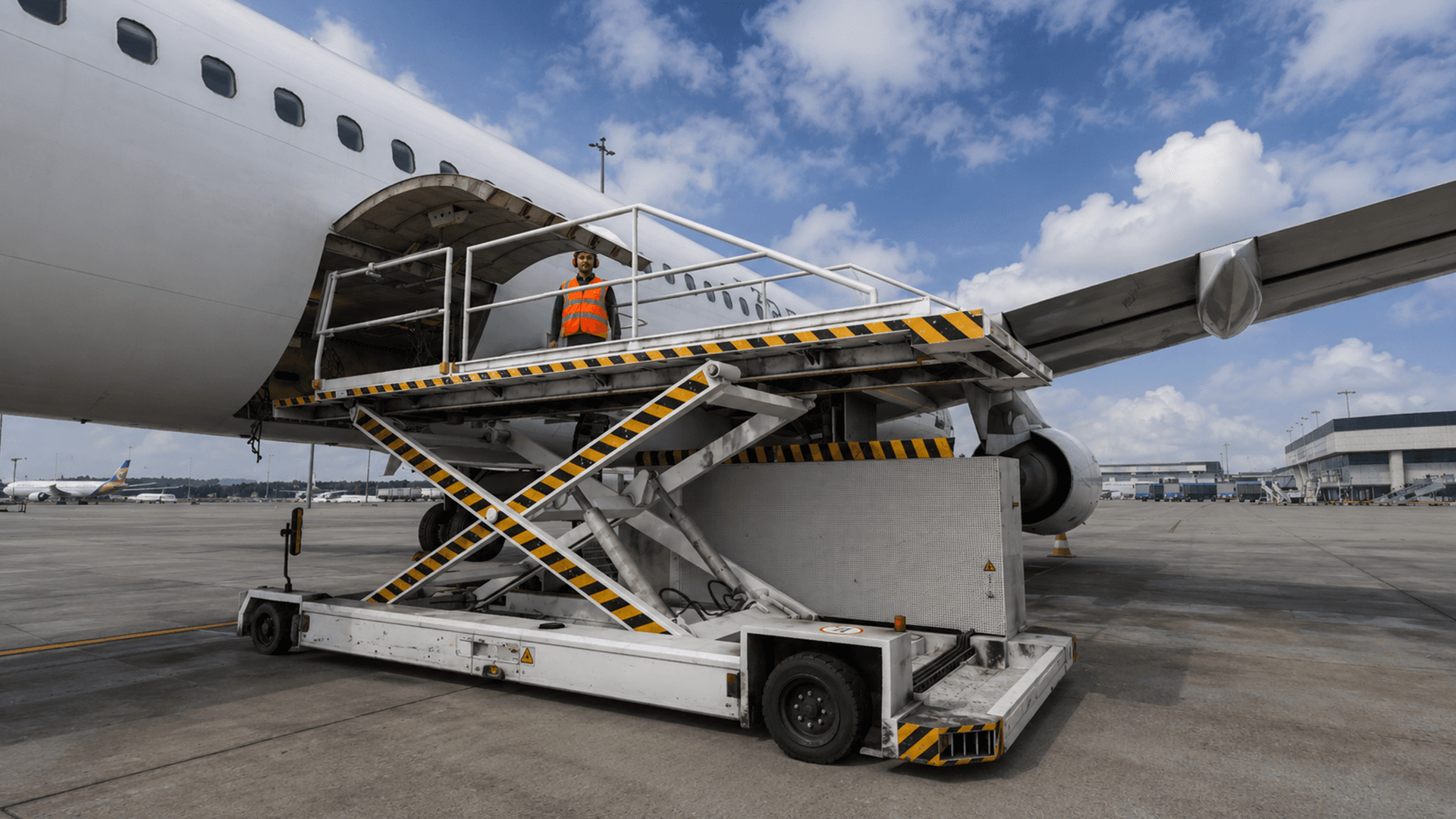
A Lower Deck Loader (LDL) is a self-propelled ground support vehicle that lifts unitized cargo such as ULDs and pallets up to the lower-deck cargo hold of narrow-body and most wide-body aircraft. It is distinguished from the Main Deck Loader (MDL), which handles upper-deck freighter cargo doors at significantly greater heights, and from the belt loader, which moves bulk baggage rather than unitized cargo.
Mechanically, an LDL is built around two platforms. A bridge at the front aligns to the aircraft cargo door, and a main platform at the rear receives ULDs from a transport dolly. Both platforms operate on a powered roller deck, with twist locks and end stops securing each unit during transfer. The two platforms move independently in elevation and tilt, and coordinating them is one of the core operator skills.
The standards framework is split. IATA AHM RMP14 Ramp Services-GSE Operations covers the equipment-side training, with the same 9-topic syllabus used across all motorized GSE: equipment overview, controls familiarization, pre-operational checks, aircraft approach and removal, damage recording and reporting, connection and disconnection, operating procedures, emergency procedures, and safety precautions. Recurrent training is required at minimum every 36 months. IATA AHM RMP09 Aircraft Loading and Unloading covers the loading workflow itself, including ULDs and pallets for narrow-body and wide-body operations. LDL training sits at the intersection of both.
In day-to-day operations, equipment varies. Common manufacturers include TLD, JBT, Trepel, Mulag, Charlatte, and Doll. Variants include single-platform and two-platform configurations, diesel and electric drive, and capacity ranges that match different aircraft generations. Operators trained on one model still need familiarization with others, since controls, lock mechanisms, and emergency procedures differ.
LDL operations integrate with several other ramp activities. The aircraft cargo hold access door (RMP07) is opened and verified before approach. Airside driving rules (RMP03) apply during the move to the stand. The loading process itself is supervised at a higher level under aircraft loading supervision (RMP17). The LDL operator works in coordination with the loader inside the cargo hold and with the loading supervisor outside.
Why training is hard in real life: live-equipment time is limited, equipment is expensive, and aircraft damage from LDL contact is among the most costly ramp incidents reported. Wind, weight balance, and lock verification all affect outcomes that cannot easily be rehearsed on the live ramp. VR training lets operators practice approach, alignment, ULD transfer, and lock verification repeatedly, with feedback on errors that would otherwise be invisible until they reached an aircraft.
Good to know
When will the Lower Deck Loader training be available?
We are currently in development. Leave your email in the form above and we will let you know as soon as it becomes available.
What is the difference between a Lower Deck Loader and a Main Deck Loader?
A Lower Deck Loader (LDL) lifts ULDs and pallets up to the lower cargo hold of narrow-body and wide-body aircraft. A Main Deck Loader (MDL) handles the upper deck of freighter aircraft, working at significantly greater heights and with larger payloads. The two units share core principles (powered roller deck, ULD locking, platform alignment) but have different controls, capacities, and aircraft compatibility.
Which aircraft types will be covered?
Initial release will cover narrow-body lower-deck operations on the Airbus A320 family. Wide-body LDL operations and Main Deck Loader (MDL) operations will follow based on customer demand. Use the form above to let us know which type matters most to you.
Is this training aligned with IATA standards?
Yes. The training content is based on IATA AHM RMP14 Ramp Services-GSE Operations for the equipment-side training, and IATA AHM RMP09 Aircraft Loading and Unloading for the workflow. Recurrent training is required at minimum every 36 months.
Can this be used for both initial and recurrent training?
Yes. The module is designed for initial qualification of new operators as well as recurrent refresher training for experienced personnel.
Why use VR training for Lower Deck Loaders?
LDL training is high-consequence and live-equipment time is limited. The platform operates within centimeters of the aircraft fuselage, and aircraft damage from LDL contact is among the most costly ramp incidents reported. VR lets operators practice approach, alignment, ULD transfer, and lock verification repeatedly, with feedback on errors before they reach a live aircraft.