
De-Icing & Anti-Icing
Aircraft de-icing and anti-icing training in Virtual Reality. Based on the Clean Aircraft Concept and ICAO Doc 9640. Covers fluid selection, application procedures, holdover time logic, and final-check communication.
What You Will Train
The full de-icing and anti-icing workflow, from pre-application inspection to Anti-Icing Code transfer.
Pre-Application Check (Clean Aircraft Concept)
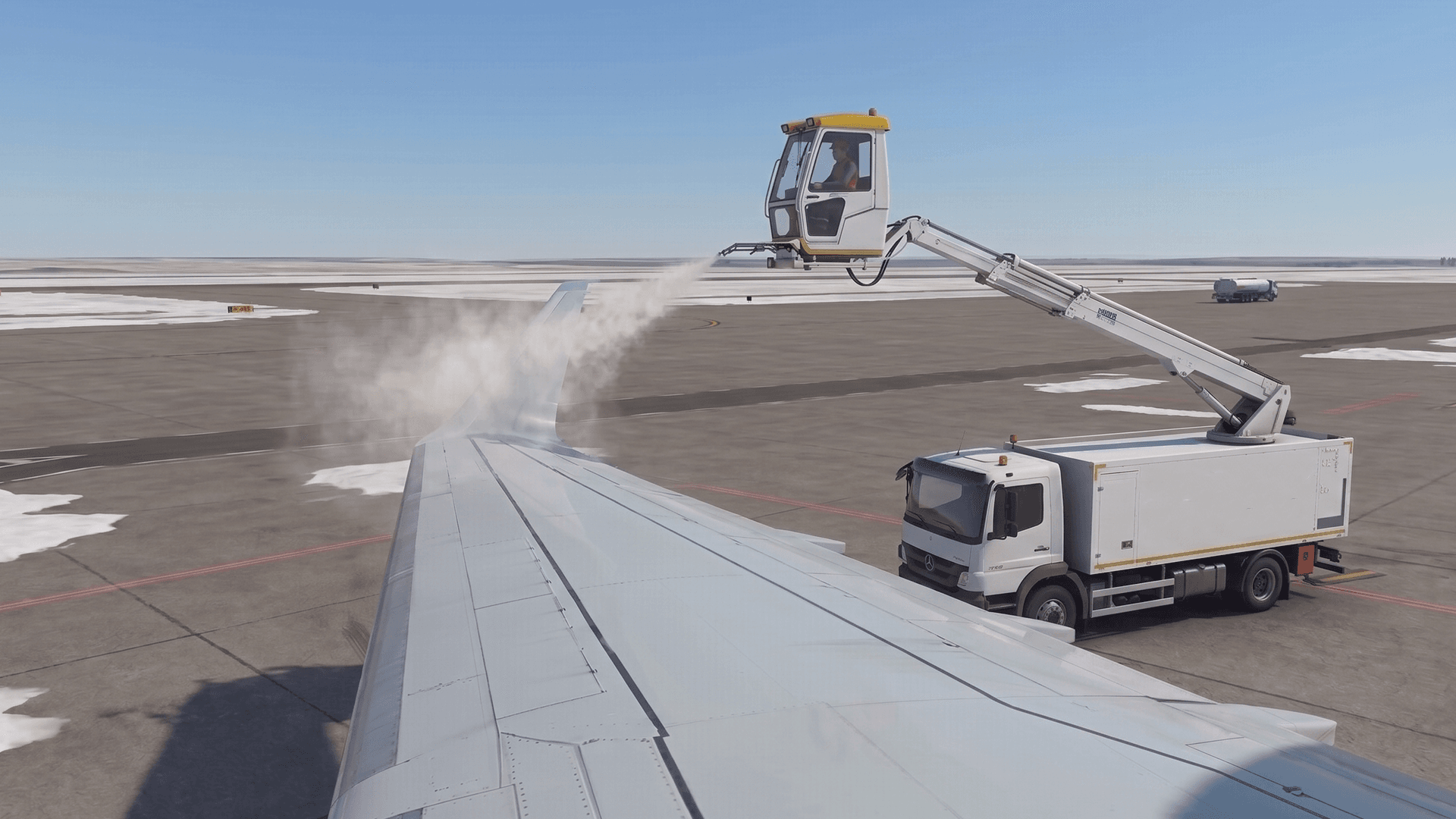
Walk-around inspection of critical surfaces for frost, snow, slush, and clear ice. Identification of fuel-tank cold-soak risk and communication of findings to the cockpit before fluid application begins.
One-Step Procedure (Type I Fluid)
Heated Type I application with fluid-to-water ratio selected from outside air temperature and wing surface temperature. Applied for active frost and lighter contamination, where anti-icing protection is not required.
Two-Step Procedure (Type I + Type IV)
First pass removes contamination with heated Type I. Second pass applies Type IV anti-icing fluid to provide protection during taxi and take-off. Standard procedure during active freezing precipitation.
Final Check & Anti-Icing Code
Visual inspection of treated surfaces, communication of the Anti-Icing Code to the cockpit (fluid type, mixture, application start time), and the All-Clear release. Responsibility for holdover time transfers to the pilot-in-command.
What Makes De-Icing Training Hard
De-icing differs from most ground handling work. The conditions, the equipment, and the consequences all shape what operators need to learn.
Time-Critical and Weather-Driven
Real de-icing only happens in winter, often under departure pressure. There is rarely time to pause, explain, or repeat a step on the live ramp.
Boom Operation Near Critical Surfaces
An articulating spray boom operates close to wings, tail, fuselage, and engine inlets. Fine joystick control and spatial awareness are not optional.
Fluid Type Decision
Type I (heated, low viscosity) versus Type IV (undiluted, thickened) is driven by outside air temperature, precipitation type, and expected taxi time.
Cold-Soak Awareness
Even with outside air temperature above freezing, cold-soaked wings from a long flight can form clear ice. Operators need to recognise and act on this risk.
Anti-Icing Code Communication
The Anti-Icing Code transfers fluid type, mix, and start time to the cockpit. The pilot-in-command uses it to determine holdover time, so there is no margin for ambiguity.
High-Stakes, High-Cost Procedure
Industry estimates put the average cost at around 2,440 USD per aircraft event in fluid alone. Errors are expensive, and missed contamination can be fatal.
Get Notified When This Launches
De-Icing & Anti-Icing is currently in development. Leave your details and we will let you know when it becomes available, and which aircraft types we are prioritizing.
De-Icing & Anti-Icing in Context
The principle behind every de-icing operation is the Clean Aircraft Concept: take-off must not be attempted when ice, snow, slush, or frost is present on the critical surfaces of an aircraft. Wind-tunnel testing has shown that contamination on a wing leading edge with a roughness similar to medium sandpaper can reduce lift by up to 30% and increase drag by up to 40%. The procedural framework around this concept is what de-icing training has to teach.
The controlling reference is ICAO Doc 9640 (Manual of Aircraft Ground De-icing/Anti-icing Operations), supported by IATA Airport Handling Manual section 3.17 and the SAE Global Aircraft Deicing Standards: AS6285 (processes), AS6286 (training and qualification), and AS6332 (quality management). Fluids are categorised by SAE/ISO into four types. Type I is a heated, low-viscosity fluid used to remove existing contamination. Type II, III, and IV fluids contain a thickener that holds them on the wing surface until take-off airflow shears them off, providing anti-icing protection for a defined holdover time. Common fluid families in operation include Clariant Safewing, Kilfrost, and Cryotech.
Application is performed either with mobile de-icing vehicles (such as the Vestergaard Elephant series, Safeaero 220, or Global Ground Support units) or with fixed gantry systems at some major hubs. The articulating spray boom typically reaches 14 to 20 meters, with anti-collision sensors to protect the aircraft. The operator works from an enclosed, heated cab and controls the boom and spray head with joysticks while coordinating with a colleague on the ground or with the cockpit directly.
Communication is structured. At most major airports, the de-icing crew uses the callsign "Iceman" on a dedicated VHF frequency. The exchange covers the chosen procedure, fluid type and mix, the surfaces to be treated, and the relevant temperatures. After application, the operator delivers the Anti-Icing Code to the cockpit. This code captures fluid type, mixture, and start time, and the pilot-in-command uses it together with weather conditions to determine the holdover time, which is the estimated period the anti-icing protection will remain effective.
Why training is hard in real life: it is weather-dependent, so the season for live practice is short. It is time-pressured, since aircraft are queued for departure. It is expensive per attempt, with both fluid cost and gate occupancy. And the consequences of error are severe. These are precisely the conditions where VR training fits, since it lets operators run the full procedure repeatedly without weather, without aircraft risk, and without fluid waste.
Good to know
When will the De-Icing & Anti-Icing training be available?
We are currently in development. Leave your email in the form above and we will let you know as soon as it becomes available.
What is the difference between de-icing and anti-icing?
De-icing is the process of removing existing ice, snow, slush, or frost from aircraft surfaces, typically using heated Type I fluid. Anti-icing is a precautionary step that follows, where Type II or Type IV fluid is applied to clean surfaces to protect against re-icing during taxi and take-off. The two procedures are usually run together as a two-step operation when active freezing precipitation is present.
Which aircraft types will be covered?
Initial release will cover the Airbus A320 family. Additional aircraft types (including A330, B737, and B777) will follow based on customer demand. Use the form above to let us know which type matters most to you.
Is this training aligned with industry standards?
Yes. The training content is based on ICAO Doc 9640 (Manual of Aircraft Ground De-icing/Anti-icing Operations), IATA Airport Handling Manual section 3.17, and the SAE Global Aircraft Deicing Standards: AS6285 (processes), AS6286 (training and qualification), and AS6332 (quality management).
Can this be used for both initial and recurrent training?
Yes. The module is designed for initial qualification of new operators as well as recurrent refresher training for experienced personnel.
Why use VR training for de-icing?
De-icing is weather-dependent, expensive per attempt (industry estimates around 2,440 USD per aircraft in fluid alone), and operationally time-pressured. VR training lets operators run the full procedure repeatedly without seasonal limits, without aircraft risk, and without fluid waste, while building the spatial awareness needed for boom operation near critical surfaces.