
Air Start Unit (ASU)
ASU operations training in Virtual Reality. Based on IATA AHM RMP14 Ramp Services-GSE Operations. Covers pre-operational checks, aircraft approach, hose connection, engine start support, and disconnect.
What You Will Train
The full ASU workflow, from pre-operational checks to engine start support and parking.
Pre-Operational Checks
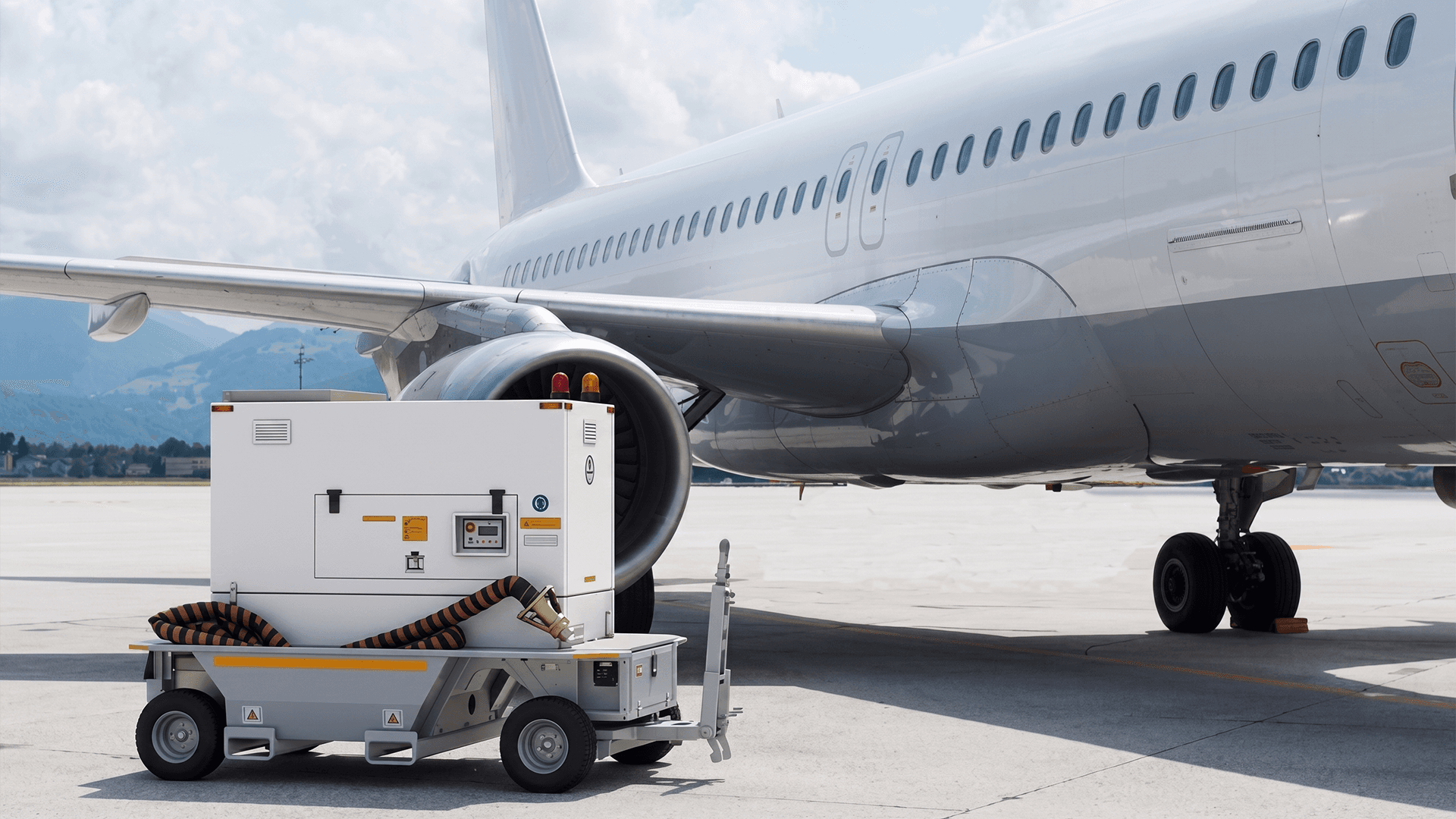
PPE, FOD inspection, equipment external state, fluid leaks, fire extinguisher status, battery isolation switch, panel and latch security, and emergency stop function. Starter temperature verified below 60 degrees Celsius before approach.
Aircraft Approach & Positioning
Brake check at 15 meters on entering the controlled approach zone, second brake check at 5 meters. Final positioning at minimum 5 meters from the aircraft and 3 meters from refuelling vehicles. Guide person used when vision is restricted.
Hose Connection & Bleed
Service panel inspection, hose deployment without kinks, adapter seating into the aircraft receptacle, valve selection on the control panel, controlled Bleed activation on request, and monitoring during engine start support.
Disconnect & Park
Authorization from the headset operator, ordered shutdown, disconnect once the hose is depressurised, hose stowage, and service panel closure. Drive to designated parking clear of fire hydrants, fuel cutoffs, and emergency exits.
What Makes ASU Training Specific
Air Start Units sit in a category of their own. The pneumatics, the connection, and the failure modes are all distinct from other ground support equipment.
Pneumatic, Not Electrical
ASUs supply high-pressure compressed air to spin the engine's air turbine starter, typically 30 to 50 psi. A Ground Power Unit supplies electricity. The two are often confused and require different training.
APU Backup or Replacement
ASUs are deployed when the aircraft APU is unserviceable, in maintenance, or when the operator chooses to save APU fuel and lifecycle. Cold-weather starts are a common scenario.
High-Pressure Hose Handling
A heavy, pressurised hose connects to the aircraft receptacle on the underbelly. Routing without kinks, seating the adapter firmly, and avoiding hose damage are hands-on skills.
Hot Start and Hung Start Awareness
Excessive exhaust gas temperature during start (hot start) or failure to reach idle (hung start) need to be recognised by the operator so the flight deck can respond in time.
Ramp Coordination
ASU operation is coordinated with the headset operator and flight deck. Brake checks, signal horn use (one for forward, two for reverse), and clearance authorization are part of every cycle.
Equipment Variety
Towable, self-propelled, and electric ASU variants are all in service. Each has different controls and connection workflows. Operators trained on one model still need familiarization with others.
Get Notified When This Launches
Air Start Unit (ASU) training is currently in development. Leave your details and we will let you know when it becomes available, and which aircraft types we are prioritizing.
Air Start Units in Context
An Air Start Unit (ASU) supplies high-pressure compressed air to start the main engines of an aircraft. It is one of several ground support equipment categories that connect to a parked aircraft and is often confused with the Ground Power Unit (GPU). The difference matters: a GPU supplies electrical power for avionics, lighting, and cabin systems, while an ASU supplies pneumatic force to physically spin the engine's air turbine starter.
The mechanics are simple in principle. The ASU's compressor or storage tank pushes compressed air through a heavy hose into the aircraft's ground air start receptacle, typically located on the underside of the fuselage near the wing root. That air drives the Air Turbine Starter (ATS), which is mechanically linked to the engine's high-pressure compressor spool. Once the engine reaches roughly 10 to 20 percent of its rated speed, fuel is introduced and ignited. The engine then accelerates under its own power, the ATS disengages, and the ASU is disconnected.
ASUs are typically deployed in three scenarios: when the aircraft's onboard Auxiliary Power Unit (APU) is inoperative or in maintenance, when extreme cold prevents reliable APU starts, or when an operator chooses to save APU fuel and lifecycle on a routine departure. Failure modes the operator needs to recognise include the hot start (excessive exhaust gas temperature) and the hung start (engine fails to reach idle speed). Both require coordination with the flight deck and an immediate response.
The standards framework is IATA AHM Chapter 11 RMP14 Ramp Services-GSE Operations (Motorized/Non-motorized). RMP14 covers a full set of GSE categories, with the Air Start Unit listed alongside Ground Power, Air Conditioning Units, Belt Loaders, and others. The course structure has 9 standard topics: equipment overview, controls familiarization, pre-operational checks, aircraft approach and removal, damage recording and reporting, connection and disconnection, operating procedures, emergency procedures, and safety precautions. Recurrent training is required at minimum every 36 months.
In day-to-day operations, ASU equipment varies. Trailer-mounted diesel units (such as those from TLD, Tronair, JBT, ITW GSE, and Guinault) are the most common. Self-propelled units appear at larger airports. Battery-electric and hybrid ASUs are increasingly used as part of zero-emission ramp programmes. Some hubs have moved to fixed gate-piped systems where compressed air is supplied through a retractable hose at the stand. Operators trained on one type still need familiarization on the others, since the controls, connection points, and procedures differ.
Why training is hard in real life: ASU operations are infrequent compared to other ramp tasks, equipment varies between operators and stations, and a poor connection or sequencing error can damage the engine or the unit itself. VR training lets operators run the full sequence repeatedly, build familiarity with different unit types, and practice scenarios like hot-start recognition that are otherwise rare.
Good to know
When will the Air Start Unit training be available?
We are currently in development. Leave your email in the form above and we will let you know as soon as it becomes available.
What is an Air Start Unit and how is it different from a Ground Power Unit?
An Air Start Unit supplies high-pressure compressed air to start the main engines of an aircraft, typically at 30 to 50 psi. A Ground Power Unit supplies electrical power for onboard systems while the aircraft is parked. The two units serve different purposes and use different connections on the aircraft.
When is an ASU actually needed?
An ASU is used when the aircraft's onboard Auxiliary Power Unit (APU) is unserviceable or in maintenance, when extreme cold prevents reliable APU-based starts, or when the operator chooses to save APU fuel and lifecycle on a routine departure.
Which aircraft types will be covered?
Initial release will cover the Airbus A320 family. Additional aircraft types (including A330, B737, and B777) will follow based on customer demand. Use the form above to let us know which type matters most to you.
Is this training aligned with IATA standards?
Yes. The training content is based on IATA AHM Chapter 11 RMP14 Ramp Services-GSE Operations (Motorized/Non-motorized), which covers ASU operations as one of its GSE categories. Recurrent training is required at minimum every 36 months.
Can this be used for both initial and recurrent training?
Yes. The module is designed for initial qualification of new operators as well as recurrent refresher training for experienced personnel.