Draxon VR Training Syllabus
Fallback: Hand Signals
 Virtual Reality
Description
This lesson trains the hand signals a headset operator needs during a pushback when the headset cannot be used, for example during lightning or a thunderstorm, or after a cable headset fails or breaks mid-pushback. A colleague demonstrates each signal and the trainee then performs it, with coaching on hand orientation, motion and how long each signal is held. The focus is on signalling clearly enough to be read at a distance, since a misread signal can move an aircraft or an engine the wrong way.
Lesson Overview
- 1Introduction to hand signals as the fallback for pushback communication when the headset is unavailable
- 2Watch a colleague demonstrate each signal, then perform it in turn
- 3Work through all 16 pushback signals, including OK, Brakes On and Air Up
- 4Per-signal coaching on form, motion and hold duration, with correction of common mistakes
Skills Acquired
- Recognize the pushback hand signals used when headset communication is unavailable
- Perform each signal with the hand orientation, motion and hold duration needed for it to be read at a distance
- Distinguish signals whose meanings are opposites, preventing conflicting instructions to the driver and flight crew
- Understand when and why each signal is used during a pushback
Lesson Procedure
- The trainee starts in the parking lot and confirms there is enough room to extend both arms fully before the lesson begins.
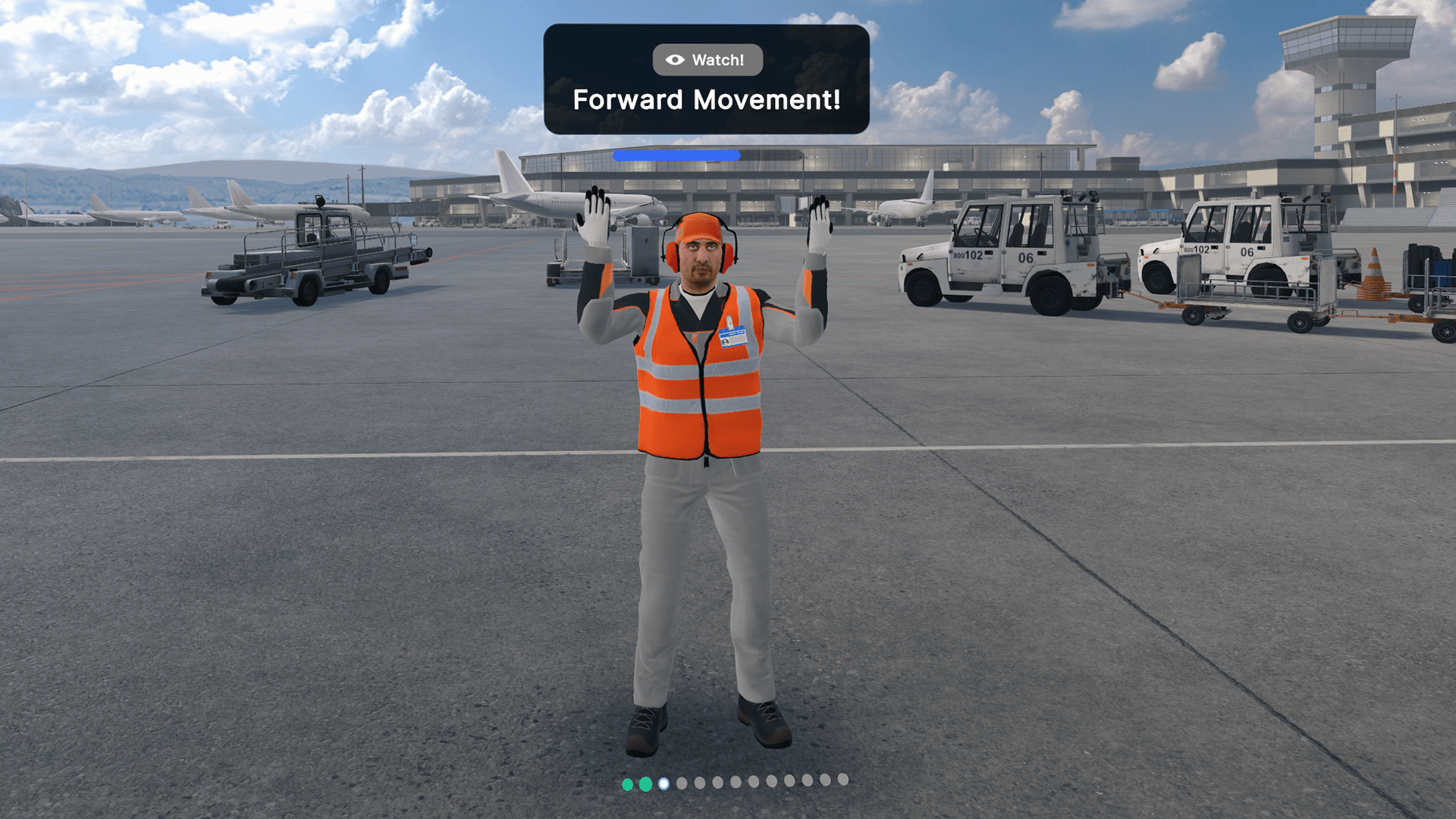
- On the apron, a colleague standing a few meters in front introduces the sequence: each signal is demonstrated first, then the trainee performs it.
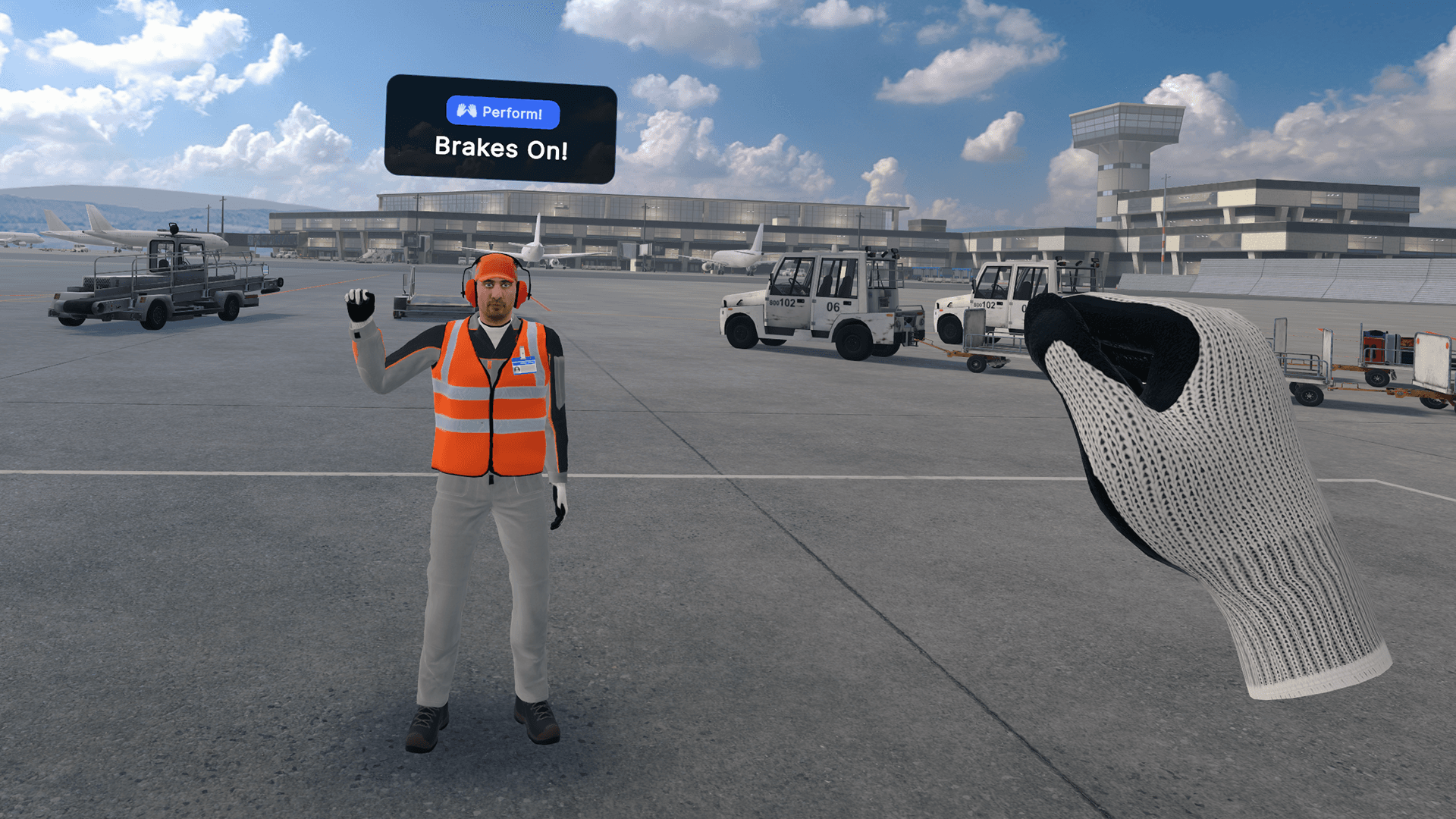
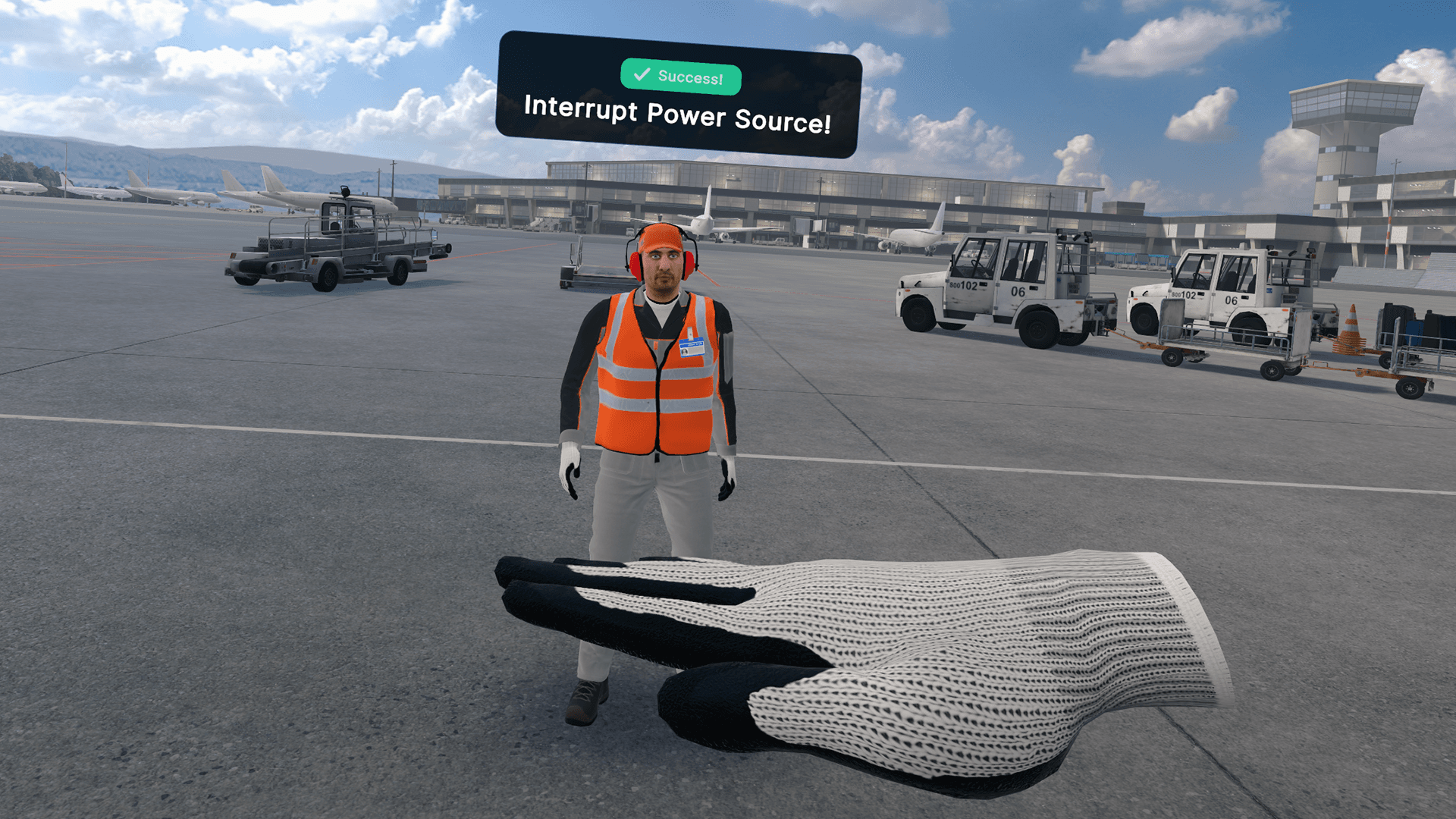
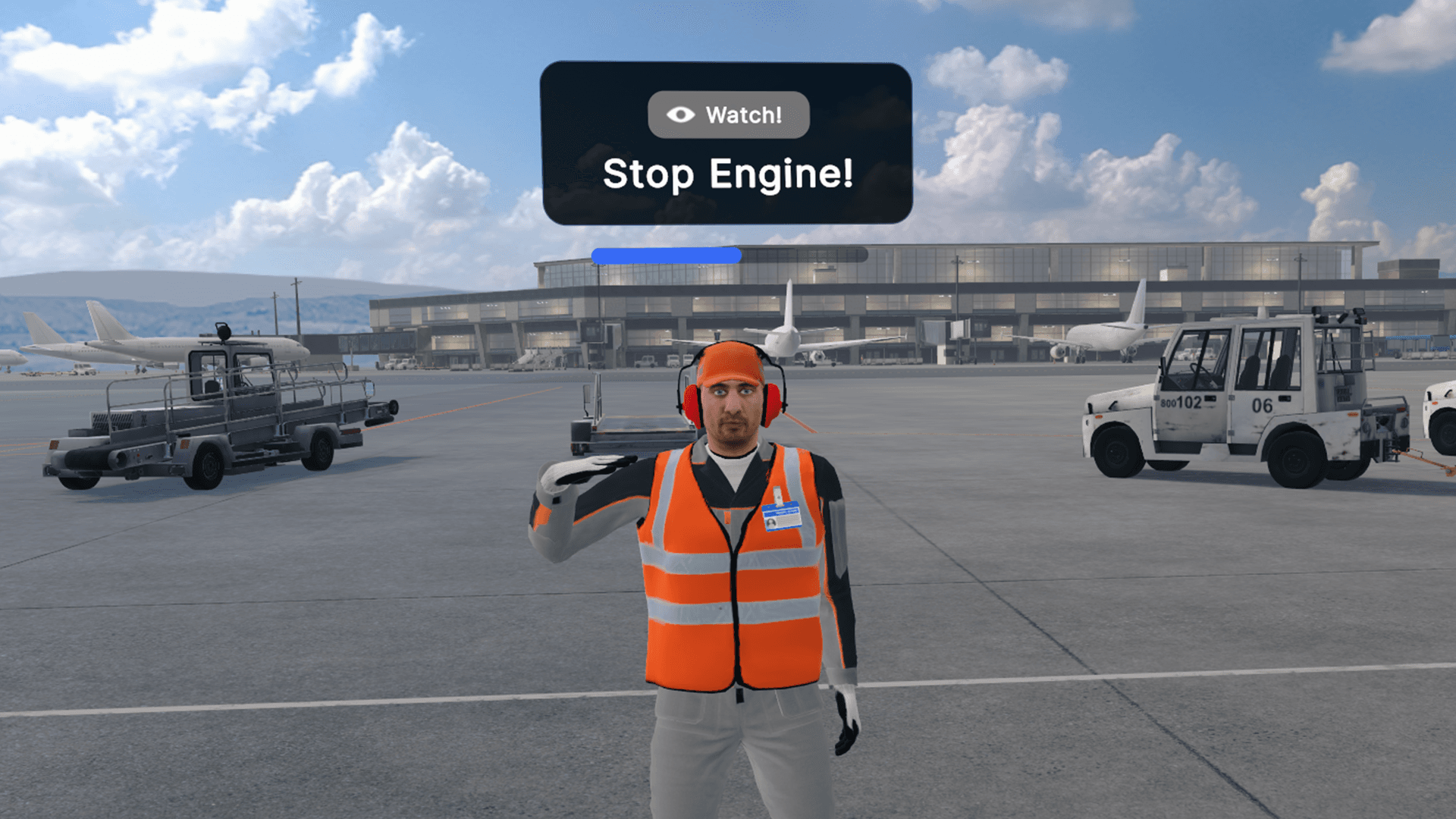
- The trainee works through all 16 signals in order: OK, Negative, Brakes On, Brakes Off, Slow Down, Change of Pushback Direction, Connect to Tow Bar, Air Up, Interphone, Chocks Inserted and Stabilizers On, Chocks Removed and Stabilizers Off, Lift, Lower, Start Engines, Stop Engine, and Fire.
- For each signal the colleague demonstrates the form and explains what it means and when it is used.
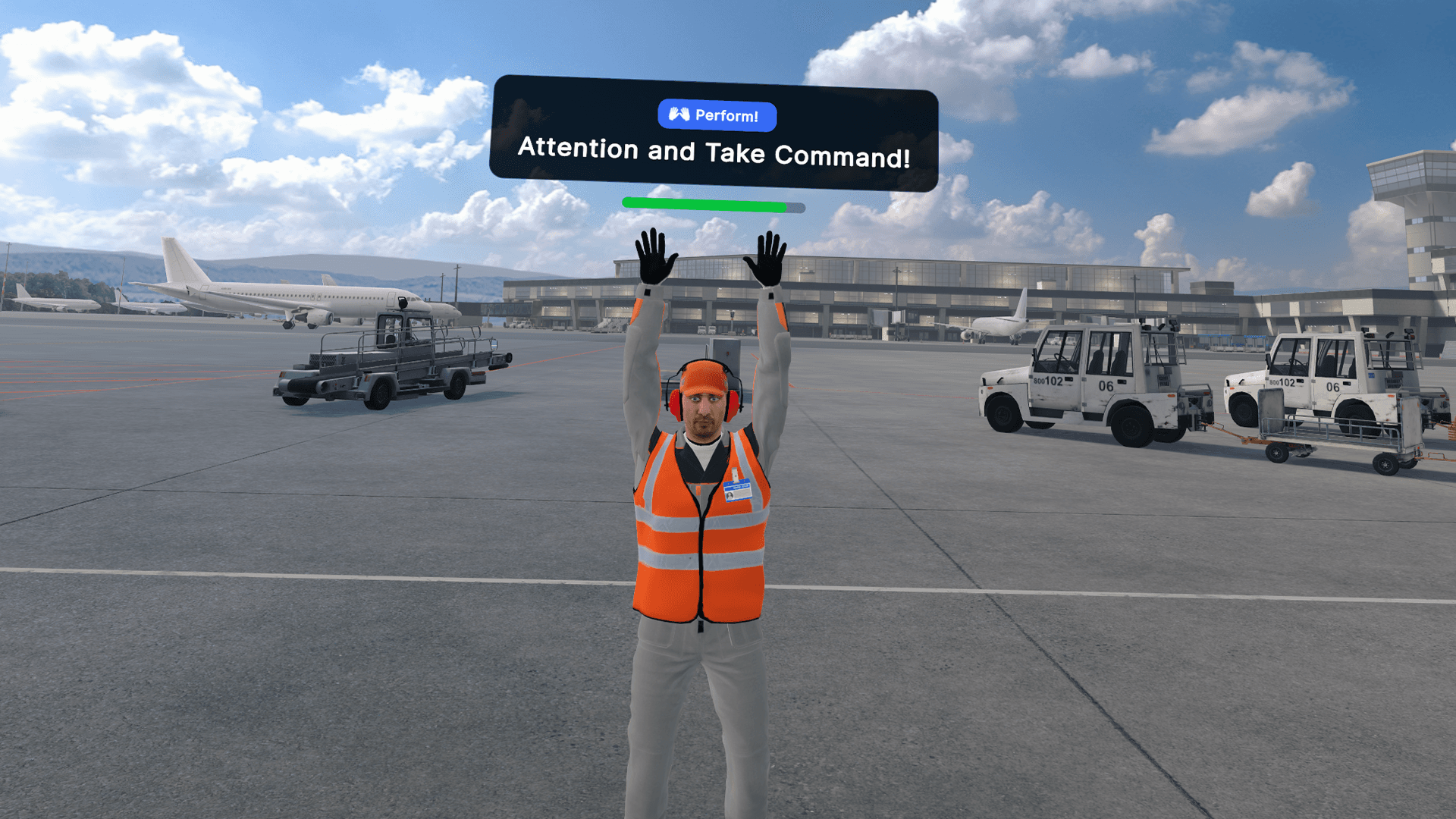
- The trainee then performs the signal, holding the steady signals for a few seconds and repeating the motion signals three times.
- Guidance focuses the trainee on three points whenever a signal is unclear: the orientation of the hands, the direction and speed of the movement, and the pose of each hand.
- The trainee can repeat any signal before moving on, and a signal that cannot be completed is set aside so the sequence continues.
- The lesson closes by confirming that all 16 signals can be recognized and performed with the correct form and motion, and that the trainee knows when each one is used.
Safety Scenarios & Learnings
Thumb pointing down during the OK signal
Correction; a reversed thumb reverses the meaning of the signal
Correction; a reversed thumb reverses the meaning of the signal
Thumb pointing up during the Negative signal
Correction; a reversed thumb reverses the meaning of the signal
Correction; a reversed thumb reverses the meaning of the signal
Second hand raised during a one-handed signal
Correction; extra hands make a signal ambiguous
Correction; extra hands make a signal ambiguous
Hand lowered before the brakes signal is complete
Retry; signals must be held until the driver has seen them
Retry; signals must be held until the driver has seen them
Chocks and stabilizers signal performed in the opposite direction
Correction; inserted and removed differ only by direction of motion
Correction; inserted and removed differ only by direction of motion
Looking away from the colleague while signalling
Reminder; a signal only works when the recipient knows it is meant for them
Reminder; a signal only works when the recipient knows it is meant for them
Signal performed too small or too quickly to be read
Reminder; clear, deliberate motion is what makes a hand signal work
Reminder; clear, deliberate motion is what makes a hand signal work
Gallery